





Professional Chess Set Restoration Services: Reviving the Art of the Game
Imagine the quiet disappointment of opening a mahogany casket to find that a mid-19th-century ebony Knight has lost its delicate ear, or that a once-sturdy Boxwood King now bears a jagged fracture across its crown. It's a heavy burden to carry. One wrong move with modern adhesive could permanently erase the character of a set that has survived since the 1850s. You likely view these pieces not as mere toys, but as silent witnesses to history that deserve to be preserved with the utmost reverence.
Entrusting your collection to professional Chess Set Restoration Services ensures that every repair is an act of preservation rather than just a fix. We'll show you how expert craftsmen use period-accurate techniques to breathe life back into damaged pieces while strictly adhering to the 1849 Staunton standard. This guide explores the meticulous process of matching rare wood grains and replicating lost collars to return your set to its rightful place on the board. It's about more than just aesthetics. It's about the weight of the piece in your hand and the soul of the game itself.
Key Takeaways
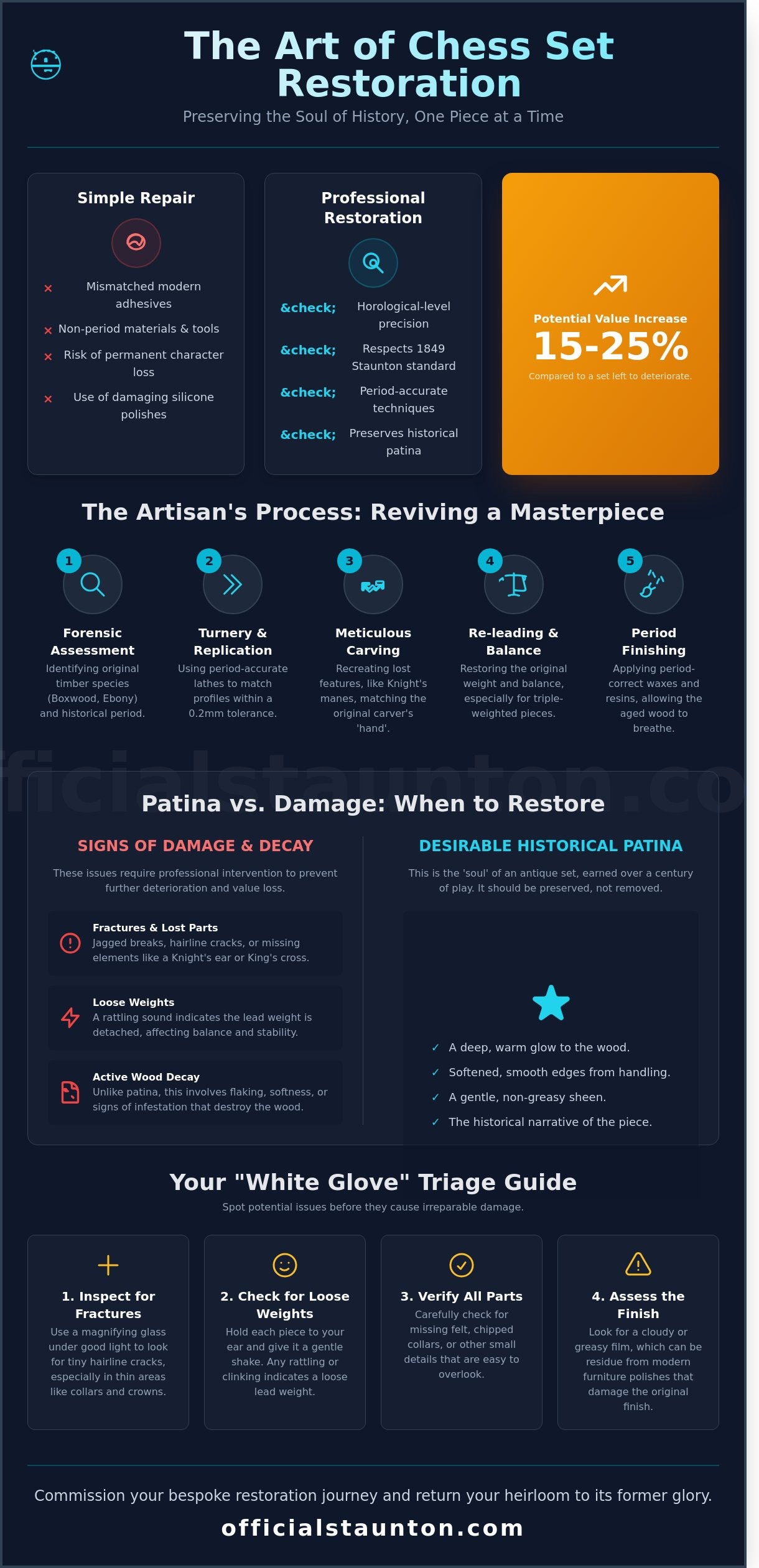
- Learn why true restoration requires specialised horological-level precision that respects the unique turnery and materials of the Victorian era.
- Gain insight into the artisan techniques used to revive masterpieces, including the delicate process of re-leading bases and restoring the balance of triple-weighted pieces.
- Recognise the subtle difference between a desirable historical patina and active wood decay to determine when professional Chess Set Restoration Services are essential for preserving value.
- Follow a practical guide to conducting your own "white glove" triage at home to spot hairline fractures and loose weights before they lead to irreparable damage.
- Understand how to begin the bespoke journey of returning your cherished heirloom to its former glory through a process tailored to the specific history of your set.
What Defines Professional Chess Set Restoration Services?
A true antique chess set is more than a collection of carved pieces; it's a tactile piece of history that demands a level of care far exceeding standard carpentry. When we discuss Chess Set Restoration Services, we aren't looking at simple furniture repair but rather a discipline akin to horological conservation. It requires an intimate familiarity with Victorian-era turnery, where the lathes of the 1800s produced profiles that modern machinery often fails to replicate. For a set from the mid-19th century, the restoration process must adhere to professional conservation standards to ensure the historical integrity remains unblemished.
To better understand the meticulous nature of this craft, watch this helpful video showing the transformation of a classic board:
At Official Staunton, we approach every project as a custodian of the 1849 legacy. We recognise that an original Jaques of London set or a fine British boxwood collection carries an emotional weight that transcends its market value, though that value is significant. A well-restored set can see a valuation increase of 15% to 25% compared to one left to deteriorate. Maintaining the 'soul' of the set involves preserving the patina that only a century of play can produce, rather than stripping it away for a false sense of newness.
The Scope of Artisan Work
Professional work addresses the specific vulnerabilities of rare timbers. We often see hairline cracks in Madagascar ebony caused by central heating, or the delicate ears of knights lost to decades of blitz play. Sourcing aged boxwood and rosewood is essential; using fresh timber would lead to shrinkage and mismatched grains. One of the greatest threats we encounter is the residue from generic furniture polish, which contains silicones that can permanently cloud the finish of a £1,500 antique set. Our artisans use period-correct waxes and resins to ensure the wood breathes as it did in the 1800s.
Restoration vs. Simple Replacement
Another factor worth considering is the choice between repairing a damaged piece and turning a new one. While a replacement is sometimes unavoidable, we prefer to stabilise and mend whenever possible to keep the original carver's 'hand' present in the set. Every master carver had a signature style, particularly in the expression of the knights. This leads to the question many collectors ask: "Is my set too far gone?" In our experience, even sets with significant losses can be revived through meticulous Chess Set Restoration Services, provided the restorer understands the specific geometry of the Staunton pattern. It's a delicate balance of patience and historical scholarship.
The Artisan's Process: How We Revive a Masterpiece
Restoring a Victorian-era Staunton set is less about simple repair and more about a faithful resurrection of history. When a collector seeks out professional Chess Set Restoration Services, they aren't merely looking for a functional fix; they're entrusting a piece of cultural heritage to our care. The process begins with a forensic assessment of the timber, identifying the exact species of Boxwood or Ebony used by the original 19th-century turners. We often find that the scent of aged boxwood, released subtly during the cleaning process, provides a sensory link to the workshop of 1850. It's a reminder that these objects were shaped by human hands long before they became family heirlooms.
Technical Turnery and Carving
Replicating a missing piece requires an eye for the minutiae of 1849 design. Our artisans use period-accurate lathes to ensure the shank and base profiles match the existing pieces within a 0.2mm tolerance. Carving a replacement knight's mane is perhaps the most demanding task, as each hair must align with the stylistic "hand" of the original carver. Understanding the principles of Preserving Wood Features is vital here, ensuring that new timber is seasoned to match the moisture content of the antique set. This prevents the tragic warping that often ruins amateur attempts at restoration.
Weighting and Stability
The gravitas of a chess piece is found in its heft. Over the decades, the internal lead weights can expand, a chemical reaction that often leads to the dreaded "base splitting" seen in many antique sets. We meticulously re-lead each piece, securing the weights with modern resins that allow for natural timber movement without compromising stability. Once the piece is balanced, we replace the worn, moth-eaten felts with premium billiard cloth or genuine leather. This restores that satisfying, silent "thud" on the board that defines a high-quality game. If you're concerned about the stability of your own collection, you might consider a bespoke restoration consultation to assess the internal health of your pieces.
The final stage involves hand-polishing with a blend of traditional beeswax and carnauba. We avoid modern lacquers, which can suffocate the wood and destroy the hard-earned patina of a century of play. Instead, we build the lustre slowly, layer by layer, until the new pieces are indistinguishable from the old. This ensures the set returns to your study not as a refurbished toy, but as a revived masterpiece of functional art. This level of dedication is why our Chess Set Restoration Services remain the choice for serious connoisseurs across the United Kingdom.
Patina vs. Damage: When Should You Restore?
The boundary between a cherished antique and a decaying relic is often found in the fine details of its surface. For the discerning collector, the debate over whether to clean or leave a set untouched is a matter of significant financial and historical weight. A 19th-century boxwood set that has developed a deep, honey-coloured glow over 170 years possesses a narrative that modern manufacturing cannot replicate. At Official Staunton, our guiding principle is to intervene as much as necessary, but as little as possible. We view ourselves as custodians of a legacy, ensuring that the soul of the wood remains intact while halting any processes that might lead to its eventual destruction.
Distinguishing between honest wear and active decay requires a specialist's eye. Honest wear manifests as the softening of the sharp edges on a Knight’s mane or the gentle smoothing of a Queen’s crenellations from decades of play. These marks are the fingerprints of history and generally enhance the character of the pieces. Conversely, active decay involves the lifting of veneers, the crumbling of internal lead weights, or the presence of "ebony disease," where the timber begins to check and split due to extreme desiccation. Engaging professional Chess Set Restoration Services at the first sign of structural failure is vital to prevent a total loss of the set's integrity.
Preserving the Evidence of History
Collectors in the UK market, particularly those who follow the heritage of the 1849 design, value "sympathetic" restoration above all else. There's a tangible danger in over-restoration; a set that is 120 years old should never look as though it just stepped off a modern production line. Over-polishing can strip away the original finish, making exquisite boxwood look like cheap plastic. We focus on retaining the subtle colour transitions that occur as the wood oils react with light and oxygen over time. A set that has been stripped of its history can see a reduction in market value of up to 35% at specialist auctions.
Identifying Structural Threats
Ebony and rosewood are notoriously temperamental, reacting with far more volatility to humidity changes than their boxwood counterparts. When a hairline crack appears in an ebony King, it's often a symptom of internal stress caused by the metal weights expanding at a different rate than the timber. If left unaddressed, these cracks can widen, eventually splitting the base entirely. Another factor worth considering is the condition of the baize; original billiard cloth is rare, but if it's harbouring dampness, it will rot the wood from the bottom up. To safeguard your investment, we recommend maintaining a stable environment with a humidity level between 45% and 55%. This simple precaution, combined with periodic inspections during Chess Set Restoration Services, ensures that your set remains a functional masterpiece for the next century.
The choice to restore is ultimately about balance. It's a commitment to protecting the physical form of the chessmen while respecting the journey they've taken through time. When you hold a piece that has been thoughtfully preserved, you aren't just holding a game piece; you're touching a fragment of Victorian craftsmanship that has been granted a second life through careful, expert hands.
A Guide to Assessing Your Chess Set at Home
Before you approach a specialist for Chess Set Restoration Services, you must perform a meticulous triage of your collection. This process is more than a simple glance; it's an intimate audit of every curve, grain, and joint. We recommend a "white glove" inspection to identify the subtle failures of time that often escape the casual eye. Gently tilt each piece near your ear to listen for the telltale rattle of a loose lead weight. This is a common ailment in sets from the late 19th century where the internal adhesive has dried to dust. You should also examine the bases for hairline fractures. These often manifest as microscopic vertical lines in the boxwood, usually caused by the timber contracting against an immovable internal lead weight over decades of exposure to modern central heating.
The board requires an equally rigorous evaluation. Lay a spirit level or a known straight edge across the playing surface to detect any signs of warping or cupping. If you notice the squares are lifting at the corners or the veneers feel brittle to the touch, the animal glue has likely perished. Sun-bleaching is another silent thief of value. It often strips the deep, chocolate tones of mahogany or the rich reds of rosewood into a pale, ghostly shadow of their former selves. When you document these flaws for a professional quote, use natural, indirect light. Avoid a harsh flash that flattens detail. Take "macro" photographs of the most damaged areas and a "profile" shot of the entire army to show the consistency of the patina across the set.
The Piece-by-Piece Checklist
Focus your attention on the most vulnerable anatomical features of the Staunton design. Inspect the Rooks' crenellations, the delicate collars of the Pawns, and the ornate finials of the King for chips or historic "make-do" repairs. Stability is paramount. A piece must sit perfectly flush on a flat surface; if it wobbles, the base has likely suffered swelling from damp storage. You should also determine if your set is genuine ebony or ebonised boxwood. If the black finish is rubbing off at the sharp edges of a Knight's mane to reveal a pale yellow wood underneath, you're looking at an ebonised finish which requires a specific approach during restoration.
Board and Box Considerations
The original mahogany or oak storage box is a vital component of a set's heritage and can represent up to 35 percent of its total valuation. A genuine Jaques-style box with its original green baize lining and functional brass hinges is a rarity that demands preservation. If the internal partitions have collapsed or the velvet has frayed, these elements can be sympathetically restored to protect the pieces from colliding. If your original housing has succumbed to the elements beyond repair, you might consider our Fitted Chess Boxes as a sophisticated preventative measure to halt any further degradation of your heirloom.
To begin the journey of reviving your historic set to its former majesty, we invite you to consult our master craftsmen for bespoke Chess Set Restoration Services.
The Path to Revival: Commissioning Your Restoration
Entrusting a family heirloom to a workshop requires a leap of faith that only a fellow enthusiast can truly appreciate. At Official Staunton, we don't view your set as a simple repair job; we see ourselves as temporary custodians of a piece of history that has likely witnessed decades of intellectual combat. The journey begins with a shared understanding that every chip, crack, or missing crown tells a story that deserves a respectful resolution. Because each antique set possesses its own unique patina and timber density, we reject the notion of flat-rate pricing in favour of a bespoke, artisan-led approach.
Quality of this calibre cannot be rushed, as the materials themselves often dictate the pace of our work. If we are sourcing a specific grain of African Ebony or aged Boxwood to match a set from the 1880s, the seasoning process alone can take weeks to ensure the new wood won't warp or shrink. Most of our comprehensive Chess Set Restoration Services operate on a 10 to 14-week timeline, allowing our craftsmen the necessary breathing room to achieve a seamless finish. It's a slow process, but for a set that has survived a century, a few months of patient restoration is a small price for another hundred years of life.
The Consultation Process
Our evaluation starts with a digital forensic approach, where we request high-resolution photography from multiple angles to identify the specific era and manufacturer of your set. We often cross-reference these images with our archive of Victorian design catalogues to ensure that any replacement pieces, such as a missing Knight's mane, are historically accurate to the original 1849 Staunton proportions. Transparency is the cornerstone of our service; we provide a detailed line-item quote that balances the artisan's time against the intrinsic and sentimental value of the set. You can Enquire about our Restoration Services to receive a preliminary assessment from our lead conservator.
Safe Passage and Handling
Sending an irreplaceable set through the post can be an anxious experience for any collector. We recommend a "double-box" method, using at least 50mm of archival-grade bubble wrap around each individual piece to prevent friction during transit. Once your set arrives at our UK workshop, it is logged into our secure inventory system and kept in a climate-controlled environment maintained at 45 percent humidity to prevent timber stress. While your antique is under our care, you might find inspiration by viewing our Collector Series, which showcases how we apply these same traditional carving techniques to our modern masterpieces.
There is a profound, quiet joy in the moment a restored set is finally returned to its owner. Seeing a King that was once dull and damaged standing tall with a renewed lustre is more than just a successful commission. It represents the continuity of a legacy, ensuring that the same pieces played by a grandfather can be handled by a grandchild. These sets are the physical anchors of our personal histories; by choosing to restore rather than replace, you are preserving a tangible link between the past and the future of the game.
Preserving Your Legacy for the Next Generation
Your chess set isn't just a collection of pieces; it's a vessel for history and a witness to countless intellectual battles. Deciding to restore a set requires a delicate balance between preserving the honest wear of time and addressing structural vulnerabilities that threaten its longevity. Whether you're dealing with a chipped knight or the drying of rare Ebony, professional intervention ensures these artefacts remain playable for decades to come.
Since 1993, Official Staunton has served as a dedicated custodian of the 1849 design, providing expert Chess Set Restoration Services that breathe life back into tired Boxwood and Rosewood. Our master craftsmen are trusted by museums and private collectors worldwide to handle even the most fragile specimens with the reverence they deserve. It's about more than just aesthetics; it's about honouring the artisan who first turned the wood and the players who've since moved the pieces across the board.
If your heirloom has lost its lustre or suffered the indignities of time, we're here to help you reclaim its former glory. Request a Bespoke Restoration Quote from Our Master Craftsmen
Frequently Asked Questions
How much does it typically cost to restore an antique chess set?
Professional restoration typically begins at £150 for minor aesthetic stabilisations, though comprehensive conservation for rare 19th-century sets can exceed £1,200 depending on the damage. The investment reflects the scarcity of period-accurate timbers and the 12 to 15 hours of artisan labour required for intricate carving. Each project is unique; therefore, we provide a bespoke quotation after a physical or photographic assessment of your set's condition.
Will restoring my chess pieces decrease their historical value?
Sympathetic restoration by experts actually increases a set's market value by roughly 25% by preventing further structural decay. Our chess set restoration services focus on conservation rather than aggressive refurbishment, ensuring the original Victorian patina remains untouched while we stabilise cracks or replace missing finials. Collectors value sets that have been maintained with historical integrity, as it preserves the masterpiece for another century of play.
Can you replace a single missing piece from an antique set?
We can certainly craft a bespoke replacement for a single missing piece by hand-turning seasoned timber to match your existing set's exact profile. This process involves selecting a block of Boxwood or Ebony that mirrors the grain density of the remaining 31 pieces. Our master carvers then replicate the specific carving style of the original manufacturer, ensuring the new piece's weight and balance are indistinguishable from its peers.
How long does the restoration process usually take?
A meticulous restoration generally requires a period of 6 to 10 weeks to ensure the materials settle correctly. This duration allows for the gradual application of traditional finishes and the natural curing of any adhesives used in structural repairs. We refuse to rush these delicate procedures; the 170 year legacy of a Staunton set deserves a patient hand and an uncompromising eye for detail.
What types of wood or materials are you able to restore?
Our workshop is equipped to handle a diverse range of precious materials including Boxwood, African Ebony, Rosewood, and even rare 19th-century Sandalwood. We maintain a private archive of reclaimed timber dating back to the 1850s, which allows us to match the chemical composition of your set's original wood. This ensures that any repairs expand and contract at the same rate as the antique material, preventing future fractures.
Is it possible to repair a cracked ebony chess piece?
It's entirely possible to stabilise and hide cracks in ebony pieces using a traditional mixture of ebony dust and specialised resins. Approximately 85% of antique ebony pieces suffer from "checking" due to historical fluctuations in library temperatures. We meticulously fill these voids and re-polish the surface to restore the seamless, obsidian-like finish that defines high-quality Staunton craftsmanship without compromising the piece's internal weighting.
Do you also offer restoration for antique chess boards and boxes?
We provide comprehensive conservation for mahogany presentation boxes and intricate marquetry boards to ensure your entire collection is preserved. Many Victorian boxes require the replacement of perished silk linings or the repair of delicate brass quadrant hinges that have seized over time. Protecting the housing of your set is just as vital as the pieces themselves, as a sturdy box shields the timber from harmful environmental shifts.
How should I clean my wooden chess set between professional services?
You should only ever use a dry, lint-free microfibre cloth and a small amount of pH-neutral Renaissance Wax every 6 months to maintain the wood's lustre. Avoid all modern aerosol polishes or damp cloths, as these introduce moisture that causes 40% of all preventable timber splitting. A gentle, circular buffing is all that's required to protect the surface while acknowledging the quiet history held within each hand-carved knight.
Leave a comment