









The Staunton Chess Set: A Definitive Guide to the World’s Most Iconic Design
A chess piece is merely a token of wood or stone until it adheres to the 1849 standards established by Nathaniel Cook and John Jaques; without this specific lineage, the game loses its universal voice. You likely recognise that selecting a genuine staunton chess set is an exercise in discerning the sublime from the merely functional, yet the modern market often obscures this path with an array of varying price points and ambiguous material claims. It's a common struggle to seek a professional-grade instrument only to find sets that lack the requisite balance, the historical accuracy, or the density of timber demanded by the serious player.
We'll guide you through the rich heritage and meticulous craftsmanship behind these iconic designs, providing the essential criteria to distinguish between a common toy and a durable investment that appreciates in value. You'll discover the technical secrets of triple-weighting and the distinct grains of genuine Ebony and Boxwood that define our standard. This guide serves as your comprehensive roadmap to owning a piece of intellectual history that offers a tactilely satisfying experience for every move you make on the board.
Key Takeaways
- Uncover the historical evolution of the 1849 Nathaniel Cooke design and its enduring status as the global benchmark for competitive elegance.
- Gain insight into the technical specifications of a professional staunton chess set, from the symbolic Victorian silhouettes to the necessity of triple-weighting.
- Evaluate the characteristics of premium timbers such as Ebony and Boxwood to determine which material best suits your environment and tactile preferences.
- Apply the "Golden Ratio" of sizing to select a set where the King’s proportions are perfectly balanced against the dimensions of your chessboard.
- Learn how to safeguard your collection by choosing sets that carry the Official Staunton legacy, backed by a comprehensive three-year warranty.
Defining the Staunton Chess Set: A Masterpiece of Victorian Utility
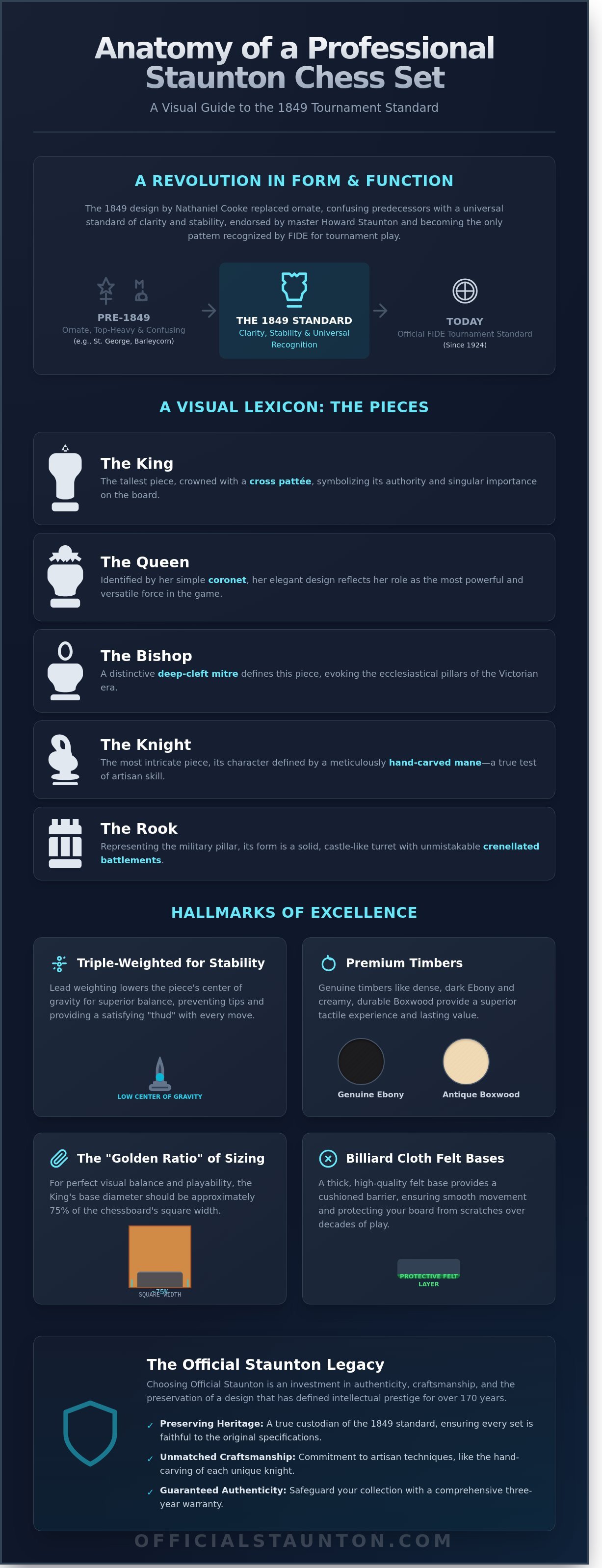
On 29 September 1849, a design was registered that would forever alter the aesthetic and functional landscape of competitive board games. This was the birth of the Staunton chess set, a pattern that moved away from the ornate, fragile excesses of the early 19th century toward a vision of neoclassical stability and clarity. Before this intervention, players struggled with the Barleycorn and St. George styles; these were often top-heavy, prone to toppling, and confusingly similar in silhouette. The 1849 design by Nathaniel Cooke solved these practical grievances by introducing a weighted, wide-based architecture that remains the only pattern recommended by the Fédération Internationale des Échecs (FIDE) for international tournament play today.
The transition to this standard was not merely a matter of fashion but a necessity for the burgeoning world of professional chess. As international travel became more accessible and tournaments more frequent, the need for a universal language of pieces became paramount. The 1849 design provided a visual shorthand that transcended borders. It ensured that a player from London and a player from Paris could compete on equal footing without the distraction of unfamiliar piece shapes. This standardisation allowed for a more rigorous focus on strategy and theory, cementing the set's place as the definitive tool for the serious practitioner.
The 1849 Original: A Revolution in Form
Nathaniel Cooke's genius lay in his ability to translate the grandeur of Victorian London into miniature wood and ivory forms. The King's crown and the Queen's coronet drew inspiration from the neoclassical columns and architectural motifs of the era, while the Bishop's mitre and the Rook's castle-like turret provided a distinct visual language. This clarity wasn't merely for show; it allowed masters to engage in rapid, high-stakes competition and even blindfold play without the tactile confusion of previous eras. By lowering the centre of gravity and standardising the heights of the pieces, the staunton chess set became a tool of precision rather than a fragile ornament. The use of lead weighting and felted bases further enhanced this stability, allowing for a satisfying "thud" when a piece was placed firmly on the board during a decisive move.
The Endorsement of Howard Staunton
The set's meteoric rise wasn't accidental. Howard Staunton, the preeminent English master who dominated the 1840s, lent his name and his signature to the original sets produced by Jaques of London. Each box carried a label with his autograph, a mark of authenticity that transformed a commercial product into a cultural standard. This was a masterstroke of marketing that aligned the physical pieces with the highest level of intellectual achievement in the game. Today, Official Staunton continues this tradition, acting as a custodian of this meticulous heritage. We ensure that the artisan techniques of hand-carving the knight's mane and weighting the bases remain true to the 1849 specifications. This dedication preserves the integrity of a design that has transitioned from a Victorian innovation to a global symbol of intellectual prestige, appealing to those who value the weight of history in every move they make.
Anatomy of Excellence: What Distinguishes a Professional Staunton Set?
To understand the enduring appeal of a professional staunton chess set, one must look beyond the surface and into the architectural rigour of its 1849 origins. Nathaniel Cooke's design didn't merely create pieces; it established a visual lexicon that reflected the social hierarchies of Victorian England. The King is crowned with a cross pattée, standing as the tallest figure of authority, while the Queen wears a simple coronet, reflecting her role as the most versatile force on the board. The Bishop's mitre, with its deep cleft, and the Rook's crenellated battlements evoke the ecclesiastical and military pillars of the era. This design achieved such universal acclaim that it became the official tournament standard, a status maintained by the World Chess Federation since its inception in 1924.
Every piece in a luxury set is finished with a base of high-quality billiard cloth, often referred to as felt. This isn't a mere decorative flourish. In the high-stakes environment of a grandmaster tournament, the rapid movement of wooden pieces across a polished board can lead to micro-scratches. The heavy felt provides a cushioned barrier, ensuring that a £500 Macassar ebony board remains pristine through decades of play. It also contributes to the muted acoustics of the game, allowing players to focus on the silent battle of wits without the distraction of harsh, scraping sounds.
The Knight: The Soul of the Set
The Knight represents the ultimate test of a master carver's dexterity. Unlike the other five pieces, which are shaped primarily on a precision lathe, the Knight requires extensive hand-carving to achieve its distinctive character. In premium collections such as the Morphy or Marshall series, the artisan meticulously sculpts the flowing mane, the flared nostrils, and the alert, focused eyes. Achieving perfect uniformity across all four Knights is the hallmark of a world-class workshop. If the musculature of the neck or the tilt of the ears varies by even a millimetre, the harmony of the entire staunton chess set is compromised. It's this human touch that transforms a gaming tool into a work of art.
Weighting and Balance: The Physics of Play
A professional chess piece must possess a certain gravitational authority. This is achieved through "triple-weighting", a process where the base of each piece is hollowed out and filled with lead or bismuth. This technical precision lowers the centre of gravity, ensuring the piece remains upright even if brushed during a frantic blitz game. A triple-weighted King might weigh 60 grams or more, providing a satisfying "thud" when placed firmly on the board. This tactile feedback is essential for the psychological rhythm of the match. For those seeking the pinnacle of stability, exploring our collection of weighted pieces reveals how this balance enhances the flow of competitive play.
- Triple-Weighting: Typically adds 30-40 grams of metal to the base of larger pieces.
- Quadruple-Weighting: Reserved for oversized sets to ensure they don't topple during rapid 3-minute games.
- Billiard Cloth: Essential for protecting the grain of luxury hardwoods like Boxwood and Rosewood.
- Symmetry: A professional set requires 100% consistency across both sides of the board.
The marriage of Victorian symbolism and modern engineering ensures that these sets are more than just collectibles. They're instruments of precision. When a player lifts a properly weighted Staunton Rook, they feel the weight of history and the intent of the craftsman. It's a physical manifestation of intellectual rigour, designed to last for generations.
Selecting Your Material: From Boxwood to Exotic Ebony
The choice of timber defines the soul of a staunton chess set. Since the design's formal debut in 1849, the pairing of Boxwood and Ebony has remained the gold standard for both competitive and ceremonial play. These organic materials aren't static; they breathe and evolve with the player. A master-crafted set reacts to its environment over decades. Boxwood, for instance, develops a deep honey-hued patina as it absorbs the natural oils from a player's fingertips during thousands of hours of contemplation. It's a living history of every gambit and endgame ever played on the board.
Wood is an incredibly sensitive medium that demands respect from its custodian. Hardwoods are susceptible to hygroscopic movement, meaning they expand or contract based on atmospheric moisture. In the United Kingdom, where central heating can drop indoor humidity below 30% in winter, a chess set requires careful placement. Maintaining a stable environment between 40% and 60% humidity is vital to prevent the dreaded hairline cracks that can occur in heavily weighted bases. This interaction between the wood and the air is why seasoned collectors often view their sets as delicate instruments rather than mere gaming pieces.
Acacia and Walnut offer a different sensory experience through their variegated grain patterns. While Ebony provides a uniform, obsidian-like finish, Acacia presents swirling burls and shifts in light that make every piece unique. These woods are favoured for their resilience. Acacia's Janka hardness rating of approximately 1,750 lbf ensures it can withstand the rigours of daily blitz games without sacrificing the elegance expected of the Staunton form. Ethical sourcing has become a cornerstone of modern craftsmanship, with artisans now adhering to strict CITES regulations to ensure the survival of these precious timber species.
Ebony and Boxwood: The Connoisseur’s Choice
Genuine Ebony, specifically Diospyros ebenum, offers a natural density and cold-to-the-touch feel that ebonised alternatives can't replicate. Ebonising involves staining Boxwood black to mimic the appearance of Ebony, a common practice for entry-level sets. However, the true connoisseur seeks the weight and depth of the natural wood. It's a material that requires immense skill to turn on a lathe, as its brittle nature can lead to shattering if the artisan's tool isn't perfectly sharp.
Boxwood's role in this partnership is equally vital. Its exceptionally fine, tight grain allows for the intricate, meticulous carving seen in the Knight's mane and the King's crenulated crown. Because the grain is so dense, it doesn't splinter under the carver's chisel, allowing for a level of detail that coarser woods like Oak or Pine could never sustain. Investing in a premium Ebony and Boxwood set, which might retail for £450 to £1,200 depending on the carving's complexity, isn't just a purchase; it's the acquisition of a legacy that will likely appreciate as these exotic hardwoods become rarer.
Alternatives: Rosewood, Acacia, and Red Sandalwood
Bud Rosewood, often referred to as Redwood, provides a striking visual alternative with its deep crimson tones and dark streaks. It's a luxury material that brings a warmth to the board, contrasting beautifully against the pale cream of Boxwood. Since the 2017 update to CITES Appendix II, the trade of Rosewood has been strictly monitored, making sets crafted from this material highly sought after by those who value exclusivity and documented provenance.
For the enthusiast seeking a commemorative piece, Red Sandalwood represents the pinnacle of the craft. It's a wood of such density that it often sinks in water, providing a natural heft to a staunton chess set that feels authoritative in the hand. Whether you choose the accessible beauty of Acacia for a study set or the rare lustre of Sandalwood for a display piece, the material you select anchors the game in the physical world, connecting you to a centuries-old tradition of woodworking excellence.
The Collector’s Guide: Choosing the Perfect Set for Play or Display
Selecting a staunton chess set involves more than a mere appreciation for fine timber; it requires a disciplined understanding of the equilibrium between the pieces and the field of play. Professional standards dictate that a King’s height should ideally measure 3.75 inches (95mm) or 4 inches (102mm). These specific heights aren't arbitrary. They provide the necessary gravitational stability and visual presence required for both intense tournament conditions and sophisticated home display. A premium set of this stature often represents an investment of £200 to £500, reflecting the artisan labour required to carve the iconic Knight with such precision.
The visual harmony of a set depends on the "Golden Ratio" of chess equipment. For a board to feel balanced, the base of the King should occupy between 75% and 80% of the square's width. If you're using a standard 95mm King with a 42mm base, a board with 55mm squares is the mathematical ideal. Deviating from this ratio affects your "tactical vision." A board that's too crowded creates a claustrophobic atmosphere where pieces overlap, while a board that's too sparse feels unfinished and fragile. Accuracy in these measurements ensures the set functions as a masterpiece of functional art.
Sizing and Proportions for Professional Play
Tournament compliance is essential for the active player. FIDE (the International Chess Federation) standards require the King height to be 95mm, with a tolerance of 10%. For a professional feel, ensure your board features 55mm squares to accommodate triple-weighted pieces. This weighting, often achieved by inserting lead or steel into the base, prevents the pieces from toppling during a rapid 5-minute blitz game. A 95mm King typically weighs between 50g and 70g, providing a satisfying "thud" upon the wood.
Legendary Series and Their Significance
Collectors often gravitate toward historical reproductions to connect with the game's heritage. The Fischer-Spassky Series replicates the minimalist, sleek aesthetic used in the 1972 World Championship in Reykjavik. This design prioritises clean lines and durability. Conversely, the Morphy Series celebrates the mid-19th century American master, Paul Morphy, who dominated the chess world around 1858. These sets feature more ornate, Victorian-inspired carving on the Rook and the Knight’s mane. Choosing between them is a choice between the brutalist efficiency of the Cold War era and the romantic elegance of the 1850s.
Achieving visual harmony also requires matching the wood of your pieces to the veneer of your board. If you've selected an Ebony and Boxwood staunton chess set, a board featuring an Ebony or Wenge border is essential. For those who prefer the warm, reddish hues of Rosewood or Padauk, a Mahogany or Walnut board provides the necessary tonal complement. Avoid mixing woods with clashing grains; the goal is to create a seamless transition from the piece to the square, ensuring the focus remains on the geometry of the game itself.
To find a set that meets these exacting historical and technical standards, you can explore the full collection at Official Staunton.
The Official Staunton Legacy: Preserving the 1849 Standard
Official Staunton has served as a dedicated custodian of the 1849 standard for over three decades. Since our establishment in 1993, we’ve sought to honour the architectural purity and aesthetic balance of the original design. This isn't merely a commercial endeavour; it's a commitment to historical accuracy. Every staunton chess set bearing our name acts as a bridge between the Victorian era and the modern study. We understand that a fine chess set is an heirloom, meant to be passed through generations. That’s why we provide a comprehensive three-year warranty on our premium ranges. If a piece is lost or damaged during the rigours of play, our commitment to providing individual replacements ensures your investment remains whole for decades. We don't believe a lost knight should render a professional set obsolete.
Our restoration workshop in Whitchurch serves as a sanctuary for timeworn masterpieces. We’ve successfully revived antique sets dating back to the mid-19th century, carefully repairing chipped crenellations on Rooks or replacing missing manes on Knights. This expertise ensures that the lineage of the game continues uninterrupted. Choosing an Official Staunton set is an investment in both art and strategy. It's a choice that prioritises the tactile satisfaction of a triple-weighted piece against the visual grandeur of a perfectly proportioned board. When you purchase from us, you’re acquiring a piece of history that's been refined by specialists who live and breathe the game’s heritage.
Bespoke Craftsmanship and Quality Assurance
Our quality control process involves seven distinct stages of inspection. Each hand-carved piece undergoes rigorous scrutiny before it leaves our workshop. Our Whitchurch-based specialists oversee this protocol, meticulously examining the grain of the boxwood and ebony. We select only the finest Grade-A timbers, rejecting approximately 15% of raw materials that don't meet our exacting standards for density and grain uniformity. We maintain the integrity of the original Staunton pattern by referencing historical archives from 1849. This ensures the height, base diameter, and "collar" details of every King and Pawn remain faithful to the Victorian proportions. Our artisans ensure that every Knight's expression is uniform across the set, a feat that requires years of apprenticeship to master.
Completing Your Collection
A masterpiece requires a worthy stage. We pair our handcrafted pieces with luxury boards and fitted boxes to create a cohesive aesthetic that commands respect in any room. To ensure your wooden set lasts for centuries, proper care is essential. We recommend the following maintenance routine:
- Maintain a stable humidity level between 40% and 60% to prevent the wood from cracking or warping over time.
- Keep the set away from direct sunlight or heat sources like radiators, which can bleach the ebony or dry out the boxwood.
- Regularly apply a high-quality, acid-free beeswax polish with a soft cloth to preserve the natural lustre of the grain.
- Store pieces in a felt-lined box when not in use to prevent accidental chips or scratches to the polished surfaces.
By following these simple steps, you ensure that your set remains as vibrant and formidable as the day it was carved. Whether you are a grandmaster or a collector of fine objects, our sets offer an unparalleled playing experience. We invite you to Explore our full range of handcrafted Staunton Chess Sets and secure your own piece of this enduring legacy.
Securing the Legacy of the 1849 Standard
Choosing a staunton chess set isn't merely a purchase; it's an acquisition of a design that's governed international play since Nathaniel Cook's 1849 patent. This iconic silhouette provides the essential balance of form and utility, transforming a simple game into a choreographed display of intellectual rigour. Whether you prefer the midnight depth of genuine ebony or the classic resilience of boxwood, the specific weighting and hand-carved detail of each piece serve to elevate the tactile experience of every move.
Since 1993, Official Staunton has acted as a meticulous guardian of this Victorian legacy. We ensure that every set passing through our hands is hand-inspected in the UK, reflecting a commitment to quality that's rare in the modern age. With a 3-Year Warranty protecting your collection and specialist restoration services available to maintain its lustre, your investment is secured for the decades ahead. Invest in a piece of history with the Official Staunton collection and bring the quiet authority of the 1849 standard to your study. Your pursuit of excellence on the board deserves a companion that's as enduring as the game itself.
Frequently Asked Questions
What is the difference between an original Staunton set and a modern one?
The original 1849 Jacques of London sets featured distinct Victorian proportions and specific carving styles, while modern versions offer refined durability and varied aesthetic interpretations. Original sets often fetch over £2,000 at auction due to their rarity and historical significance. Modern interpretations maintain those iconic silhouettes but utilise contemporary seasoning techniques to ensure the wood resists warping in central heating. This ensures the Official Staunton signature remains a hallmark of quality for today's collectors.
Why are Staunton chess sets the only ones used in professional tournaments?
FIDE International Chess Federation regulations established in 1924 mandate the Staunton pattern because its clear, recognisable shapes prevent player confusion during high-stakes matches. The design's stability and standardisation allow grandmasters to focus entirely on strategy rather than identifying abstract pieces. Since the mid-19th century, this uniform aesthetic has been the global benchmark for competitive integrity. It's the only design that provides the necessary clarity for international broadcast and professional play.
What wood is best for a luxury Staunton chess set?
Genuine Ebony and Boxwood remain the gold standard for a luxury staunton chess set due to their immense density and exquisite grain. Ebony provides a natural, deep black lustre that requires no staining; meanwhile, Grade-A Boxwood offers a buttery, ivory-like finish. These hardwoods possess a Janka hardness rating exceeding 2,500 lbf, ensuring the pieces survive decades of rigorous play. It's a material choice that defines the heritage and prestige of a true heirloom collection.
How do I know if my chess pieces are correctly sized for my board?
You should ensure the King's base diameter occupies between 75% and 78% of the square size on your board for the best experience. For a standard 95mm King, a board with 55mm squares provides the ideal visual balance and room for movement. If the pieces cover more than 80% of the square, the field becomes cluttered; if they cover less than 70%, the board appears sparse and disconnected. Proper scaling is essential for maintaining the game's aesthetic rhythm.
What does "triple-weighted" mean in a Staunton chess set?
Triple-weighted indicates that lead or steel slugs are meticulously inserted into the base of each piece to reach a specific weight threshold, typically around 1,500 grams for a full set. This process lowers the centre of gravity, making a staunton chess set feel substantial and resistant to accidental tipping. A triple-weighted King often weighs over 70 grams, providing a satisfying thud when placed on the board. This added mass is a hallmark of premium artisan craftsmanship.
How should I clean and maintain my wooden Staunton chess pieces?
You should lightly buff the pieces with a soft, lint-free microfibre cloth and apply a small amount of high-quality Renaissance Wax every 12 months. Avoid liquid polishes or damp cloths, as moisture can cause the wood grain to swell or crack over time. Maintaining a consistent humidity level between 40% and 55% in your study will preserve the artisan carving for future generations. It's a simple ritual that protects the integrity of the precious hardwoods.
Are all Staunton chess sets handmade?
Approximately 90% of premium wooden Staunton sets are turned on a lathe and finished by hand, whereas mass-produced plastic sets are injection-moulded. The Knight remains the most complex element, requiring a master carver to spend up to two hours on a single piece to achieve the intricate mane and facial details. This manual labour ensures that no two sets are identical, reflecting a unique artistic heritage. Every piece we produce undergoes a rigorous 10-point inspection process.
Can I buy replacement pieces if I lose a member of my Staunton set?
Official Staunton provides a bespoke replacement service for clients who have lost a piece from their collection, with individual pieces starting from approximately £15. Because wood is a natural material, we recommend sending a photo of your existing set to ensure the grain and stain match perfectly. We've assisted over 500 collectors in the last year to restore their sets to their former glory. This service ensures your investment remains a complete and functional masterpiece for life.
Leave a comment