






The Art of Chess Set Woodworking: A Masterclass in Precision and Heritage
A single millimetre of deviation on the lathe marks the boundary where a mere plaything ends and a legacy heirloom begins. You likely recognise that the true challenge of chess set woodworking lies not just in the initial turn, but in the relentless pursuit of repeatability across thirty-two exacting pieces. It is a discipline that demands a marriage of Victorian design principles and modern technical precision, especially when one attempts to honour the iconic 1849 Staunton silhouette that defines the game's history.
In this masterclass, you will discover the meticulous craftsmanship and woodturning secrets necessary to produce a luxury set that commands the same respect as a grandmaster's equipment. We shall examine why certain timbers like Boxwood and Ebony remain the gold standard for durability and contrast. Another area we will explore is the complexity of hand-carving the Knight and the structural methods used to mitigate wood movement in inlaid boards. By the end, you will appreciate the subtle, vital differences that elevate a piece from a hobbyist project to a collector-grade masterpiece.
Key Takeaways
- Delve into the 1849 origins of the Staunton pattern to understand why this specific architectural form remains the undisputed gold standard for the serious player.
- Discover why the traditional pairing of Boxwood and Ebony is essential for achieving the perfect balance of aesthetic contrast and structural longevity.
- Uncover the technical secrets of chess set woodworking, specifically how master turners use story sticks and callipers to maintain absolute precision across sixteen identical pawns.
- Learn the engineering principles required to manage natural wood movement, ensuring your inlaid board remains perfectly level and seamless throughout the seasons.
- Gain insight into the meticulous finishing process, from the hidden art of triple-weighting to the application of the finest billiard cloth for that signature tactile feel.
The Architectural Foundation of the Staunton Pattern
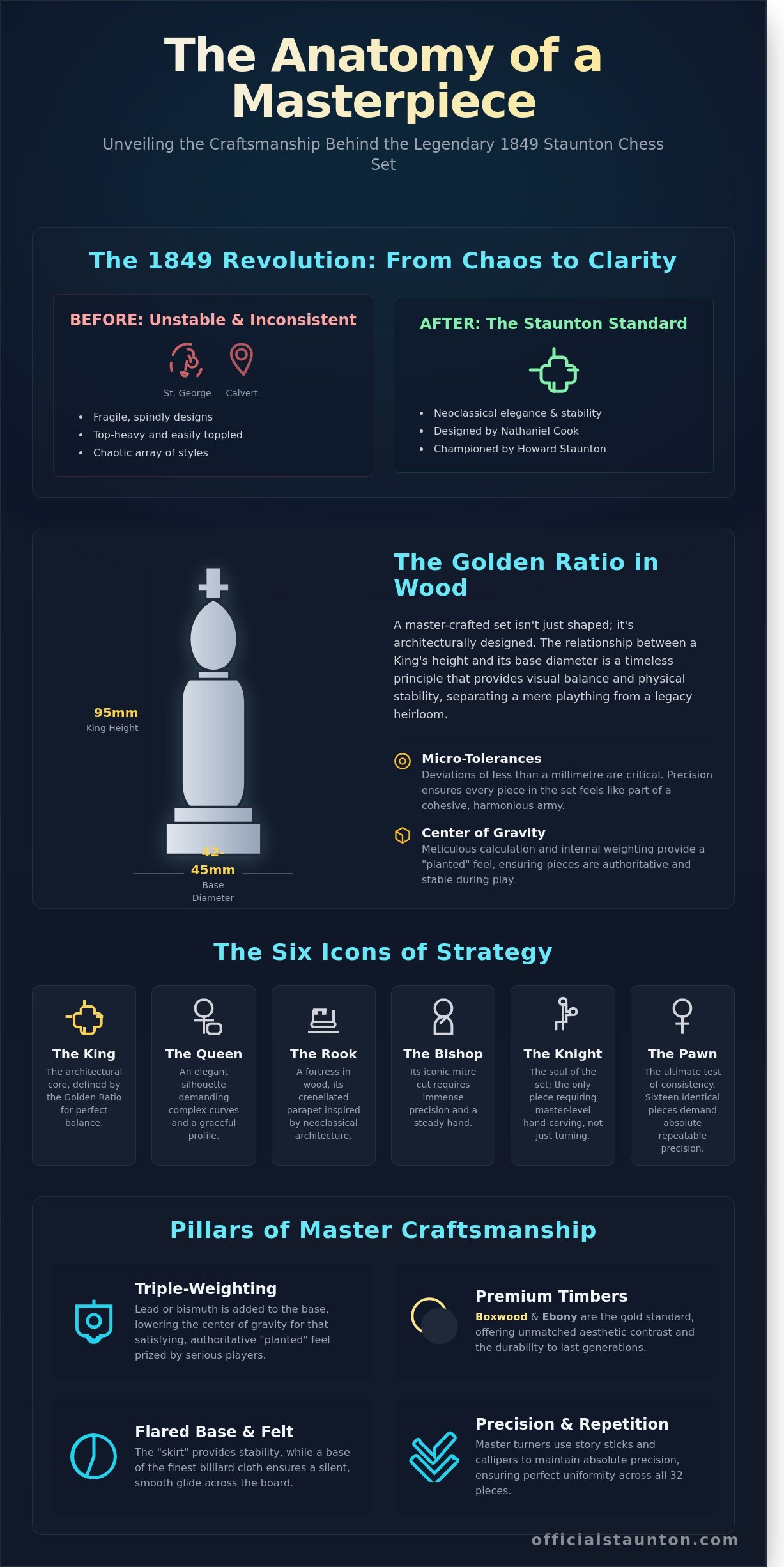
The history of the modern game changed forever in 1849. Before this pivotal year, players struggled with a chaotic array of designs, from the spindly and fragile Calvert sets to the top-heavy St. George patterns that frequently toppled during intense matches. The revolution arrived when Nathaniel Cook designed a set, which was subsequently manufactured, combining neoclassical elegance with robust stability. This design was championed by Howard Staunton, the era's premier player, and it quickly became the definitive standard for international competition. For those of us dedicated to chess set woodworking, this history isn't merely trivia; it's a blueprint for excellence that dictates every cut of the chisel and every pass of the sandpaper.
The Staunton design is widely considered the gold standard of functional art because it balances aesthetic grace with practical utility. Unlike general furniture making or decorative spindle turning, crafting a luxury chess set requires a mastery of micro-tolerances. A chair leg might vary by a millimetre without consequence, but a King that deviates from its brethren by even a fraction of that measurement will appear clumsy to the discerning collector. The architectural integrity of a set relies on the Golden Ratio, specifically the relationship between the King’s height and its base diameter. A traditional 95mm King typically demands a base diameter of approximately 42mm to 45mm, creating a visual weight that feels both grounded and authoritative on the board.
This precision is what separates a master craftsman from a hobbyist. When we approach the lathe, we aren't just shaping timber; we're honouring a legacy of proportions that have remained largely unchanged for over 170 years. The Staunton chess set serves as the ultimate test of a turner's skill, requiring the repetition of complex curves across sixteen identical pawns, a task that demands immense concentration and a refined touch. You might wonder why such rigid adherence to Victorian standards remains necessary. The answer lies in the tactile satisfaction of a perfectly balanced piece, an experience that mass-produced plastic sets can never hope to replicate.
The Symbolism of the Six Traditional Pieces
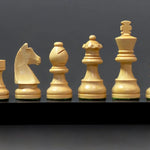
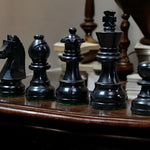
Each piece in a Staunton set is a masterclass in Victorian social hierarchy translated into woodturned silhouettes. The Rook, with its clean lines and crenellated parapet, draws directly from neoclassical architecture, evoking the strength of a fortress. The Bishop’s mitre is a subtle nod to ecclesiastical authority, while the Knight remains the only piece that requires hand-carving rather than pure turning. Interestingly, the Pawn is often the most difficult element to master. Its simplicity is deceptive; achieving perfect uniformity across sixteen pieces requires a level of consistency that tests the limits of manual chess set woodworking. Every curve must be identical to ensure the set feels like a cohesive unit.
Proportions and Playing Balance
A luxury chess piece must do more than look beautiful; it must feel substantial in the hand. We achieve this by meticulously calculating the centre of gravity, often through the addition of lead or bismuth weights hidden within the base. The "skirt," or the graceful flare at the bottom of the piece, isn't just for show. It provides the necessary surface area for stability and accommodates the traditional felt or billiard cloth that allows the piece to glide across the board. Historical iterations, such as the famous Morphy Series from 1851, continue to influence modern artisans. These sets featured a broader base and a lower centre of gravity, providing a "planted" feel that serious players still prize today for its authoritative presence during a game.
The enduring appeal of the Staunton pattern lies in this marriage of mathematical precision and artistic expression. As custodians of this craft, we recognise that every set we produce is a continuation of a story that began in a London workshop in the mid-19th century. By respecting these architectural foundations, we ensure that the spirit of the 1849 revolution lives on in every move a player makes.
Selecting Timbers for Longevity and Aesthetic Contrast
The choice of timber is the foundation of any piece of functional art. Within the context of chess set woodworking, the artisan must look beyond the surface beauty of a log to understand its internal soul. Since the mid 19th century, the interplay between light and dark woods has defined the game's visual language. This isn't merely a stylistic choice; it's a technical necessity. A master turner seeks woods that possess a Janka hardness rating high enough to withstand decades of play while maintaining the sharp, architectural lines required by the Staunton pattern. The technical demands of chess set woodworking require a deep understanding of how timber reacts to the chisel under immense pressure.
The classic pairing of Boxwood and Ebony remains the undisputed pinnacle of the craft. Boxwood, with its pale, buttery hue, offers a density that allows for the most intricate carving, particularly in the expressive features of the Knight. Ebony provides the perfect counterpoint, offering a weight and natural lustre that feels substantial in the hand. However, working with these materials requires immense patience. If the timber hasn't been seasoned for at least three to five years to reach a stable moisture content of approximately 10 percent, the finished pieces will inevitably develop hairline fractures as they adjust to the humidity of a modern home.
High speed woodturning introduces significant thermal stress to the material. When a lathe rotates at speeds exceeding 1,800 RPM, the friction between the gouge and the timber generates intense heat. Exotic hardwoods like Ebony are notorious for being temperamental under these conditions. They can shatter like glass if the tool isn't kept at a razor's edge or if the craftsman applies too much pressure. Another factor worth considering is the ethical landscape of timber sourcing. Since the 2017 CITES regulations tightened the trade of various Rosewood species, the responsible woodworker must ensure every block of Dalbergia or Ebony is accompanied by proper certification to protect these dwindling natural resources.
The Light Side: Boxwood and Maple
Boxwood is the gold standard for the white pieces because its grain is so fine it's almost invisible to the naked eye. This allows the artisan to carve crisp, clean details that won't be obscured by distracting wood patterns. While Maple is a popular alternative for entry level sets, it lacks the waxy, self lubricating oils of Boxwood. These natural oils are essential because they prevent the wood from becoming brittle and cracking over time, especially in the delicate crown of the Queen or the cross of the King.
The Dark Side: Ebony, Rosewood, and Walnut
Genuine Ebony is a difficult mistress in the workshop. Its tendency to splinter makes it one of the most challenging woods to master, yet its deep, obsidian finish is incomparable. For those seeking a softer, more vintage aesthetic, Rosewood offers a rich tapestry of reds and browns that evokes the prestigious clubs of the Victorian era. More modern artisans are increasingly turning to African Blackwood or Cocobolo. These timbers offer similar density to Ebony but often prove more stable during the drying process, reducing the risk of a set warping years after it was purchased. Selecting a set crafted from these exquisite heritage timbers ensures the board remains a focal point for generations.
Choosing the right timber is a balancing act between the physical properties of the wood and the vision of the maker. A piece of Ebony might look perfect on the shelf, but its true quality is only revealed when the first shaving is taken. This relationship between the artisan and the raw material is what separates a mass produced toy from a legacy heirloom that will be passed down through the ages.
The Master Turner’s Challenge: Repeatability and the Knight
Turning a single pawn is an exercise in form; crafting sixteen identical ones is a test of psychological and technical discipline. In the rigorous world of chess set woodworking, the artisan must suppress the urge for individual variation in favour of a rigid, mathematical consistency. When a collector gazes across the ranks of a premium Staunton set, any deviation in the height of a collar or the curve of a fillet becomes a glaring distraction. Achieving this level of uniformity by hand requires more than just a steady eye. It demands a systematic approach that bridges the gap between art and engineering.
The craftsman begins by establishing a rhythm. There is a specific cadence to the way the tool meets the spinning timber, a sensory feedback loop where the sound of the shavings and the vibration in the handle signal the depth of the cut. To maintain a tolerance of 0.2mm across an entire set, the turner relies on physical benchmarks rather than visual guesswork. This is where the heritage of the craft meets the necessity of precision, ensuring that the final product feels like a cohesive whole rather than a collection of disparate parts.
Mastering Repeatable Cuts on the Lathe
The secret to perfect repetition lies in the story stick. This is a thin strip of wood marked with the exact vertical positions of every architectural feature of the piece. By holding this against the spinning workpiece, the turner can mark the transitions for beads and coves with absolute certainty. Precision callipers are then used to verify diameters at every critical junction. A master often keeps a "master piece" nearby, frequently stopping the lathe to compare the silhouette of the new piece against the established standard.
- The Skew Chisel: Often considered the most difficult tool to master, a razor-sharp skew is essential for creating the glass-smooth finish that defines luxury sets. It leaves a surface so clean that minimal sanding is required.
- Preserving Detail: Over-sanding is the enemy of fine woodworking. It rounds off the crisp "steps" and fillets that give a Staunton set its architectural authority. Artisans use fine-grit papers backed by a hard block to keep these edges sharp.
- Muscle Memory: After forty years at the lathe, a turner's hands often "know" the curve of a Queen's crown before the tool even touches the wood.
Carving the Knight: The Soul of the Set
While the other pieces are defined by their symmetry, the Knight is the only member of the set that breaks the rules of the lathe. It begins its life as a turned "blank" or "bollard," but its true character is revealed at the carver's bench. This transition from the mechanical rotation of the lathe to the organic, freehand work of the chisel is where the artisan's personality truly shines. Mapping the horse’s features onto the wood requires a deep understanding of equine anatomy and the specific aesthetic of the 1849 Cook design.
To achieve the "fine-line" detail seen in the highest quality sets, the carver employs specialised V-tools and micro-gouges. These tools allow for the delicate rendering of the mane's individual strands and the flared nostrils that suggest a sense of spirited movement. The Knight’s expression is paramount. A fraction of a millimetre's difference in the depth of the eye socket can change a look of noble defiance into one of mere vacancy. For a set valued at £800 or more, the carver might spend up to five hours on a single Knight to ensure the gaze is perfectly symmetrical and the posture is historically accurate. This meticulous attention to detail is what transforms a simple gaming piece into a work of functional art that carries the weight of the Official Staunton legacy.
You might wonder why such an emphasis is placed on a single piece. The Knight is often the first thing a connoisseur examines when evaluating a new set. It serves as a signature of the workshop's skill. If the Knights are expressive and identical in their ferocity, it’s a guarantee that the rest of the chess set woodworking has been executed with similar reverence. This balance between the mathematical repetition of the pawns and the artistic soul of the Knight creates the unique tension that makes a luxury chess set so compelling to hold and behold.
Constructing the Board: Managing Movement in Inlaid Squares
Wood is never truly a static material; it remains a living, breathing entity that responds to the invisible currents of the atmosphere. In the delicate discipline of chess set woodworking, the greatest challenge lies in the board's inherent desire to move. A solid timber board, while seemingly robust, is a perilous venture for the artisan. Because wood expands and contracts across its grain rather than along its length, sixty-four individual blocks of solid ebony and boxwood glued together will eventually exert enough force to tear the frame apart. This internal tension can lead to unsightly gaps or, in the worst cases, structural failure within just twelve months of completion.
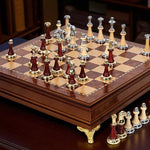
To achieve the level of precision demanded by the Official Staunton standard, the master craftsman employs the art of inlay. By bonding thin veneers of premium hardwoods to a stable, man-made substrate, we neutralise the natural movement of the timber. This technique ensures that the playing surface remains perfectly level for generations. When calculating the dimensions, a specific ratio must be observed. For a standard 95mm King, a square size of 55mm is the historical preference. This provides enough breathing room for the pieces without making the board feel cavernous, maintaining the visual equilibrium established by the 1849 design.
The Inlay Process vs. Solid Block Construction
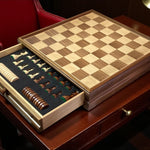
Stability is the hallmark of a professional board. We find that using a 3mm thick veneer provides the perfect balance between durability and structural integrity. Every square must be cut with surgical precision to ensure the joints are invisible to the naked eye. It is vital that the grain of every light and dark square runs in the same direction, typically parallel to the player. This uniformity prevents the board from looking chaotic and ensures that light reflects off the surface in a consistent, pleasing manner. If you are seeking a surface that mirrors this level of technical perfection, explore our exquisite range of wooden chess boards which are crafted to these exact specifications.
The transition from the playing field to the border requires an equally meticulous touch. A decorative stringing, often a mere 1mm or 2mm strip of boxwood or holly, acts as a visual bridge between the squares and the outer frame. This delicate detail serves to frame the "battlefield" and is a signature of high-end British cabinetry. The mitred corners of the outer frame must be reinforced with hidden splines to prevent them from opening during the dry winter months when central heating reduces indoor humidity to below 30%.
Finishing for the Connoisseur
The final aesthetic of the board is determined by the finish, which must be as pleasing to the touch as it is to the eye. While a high-gloss French polish using traditional shellac offers a breathtaking depth, it can create distracting glares under modern LED lighting. Many serious players now prefer a satin or matte lacquer. This approach provides a smooth, tactile experience that allows the hand to glide across the surface while protecting the wood from the oils of the skin. Another factor to contemplate is the grain fill; using a clear filler prevents the dark dust of rosewood or ebony from migrating into the pores of the lighter maple or boxwood squares, preserving the crisp contrast that defines a luxury board.
Protecting the finished masterpiece is the final step in the artisan's journey. Wood is sensitive to ultraviolet light, which can cause the rich purples of rosewood to fade or the creamy whites of boxwood to turn a deep amber over several years. A finish with integrated UV inhibitors is essential for preserving the original palette of the timber. This commitment to longevity ensures that the board does not merely serve the current generation but becomes a cherished heirloom, carrying the weight of history and the spirit of the game into the next century. The result is a surface where the only movement is the strategic dance of the pieces, underpinned by a foundation of unwavering stability.
Beyond the Lathe: The Finishing Touches of a Luxury Set
The lathe eventually falls silent, but the journey of a master craftsman is far from over. This final stage of chess set woodworking is where a beautiful object transforms into a precision instrument for the mind. While the visual allure of a boxwood or ebony piece is undeniable, its true quality is often hidden within the base. We believe that the internal architecture of a chess piece is just as vital as its external profile. A piece that feels hollow or light in the hand lacks the gravitas required for serious play, which is why triple-weighting remains a non-negotiable standard for the Official Staunton brand.
The process involves more than just adding mass; it requires a delicate understanding of equilibrium. We use lead or steel inserts, carefully measured to ensure that a King from our premier collections carries a satisfying weight of approximately 75 to 90 grams. Once the weight is seated, we apply the finest billiard cloth or premium leather felts to the base. This isn't merely for show. A high-quality green baize or a soft hide base protects the polished surface of a £500 mahogany board from scratches while providing that signature, dampened "thud" when a move is executed. Before any set leaves the workshop, it undergoes a final inspection where we check for absolute symmetry and tactile perfection, ensuring no stray grain or uneven finish disrupts the player's focus.
Weighting and Balancing for the Professional Player
Precision drilling is the first step in successful weighting. We use a Forstner bit to create a clean, flat-bottomed cavity in the base of the piece, taking care not to compromise the structural integrity of the shank. If the hole is even a fraction off-centre, the piece will lean, ruining the aesthetic of the ranks. Securing the weights is equally critical. We've found that using a combination of industrial-strength epoxy and sawdust prevents the dreaded "rattle" that can plague lesser sets after a few years of temperature fluctuations. You might wonder if the weight really matters during a game. The psychological impact is profound. A heavy piece feels authoritative; it stays rooted to the square during a frantic blitz match and signals to your opponent that every move is a deliberate, weighted decision.
The Hallmarks of Official Staunton Quality
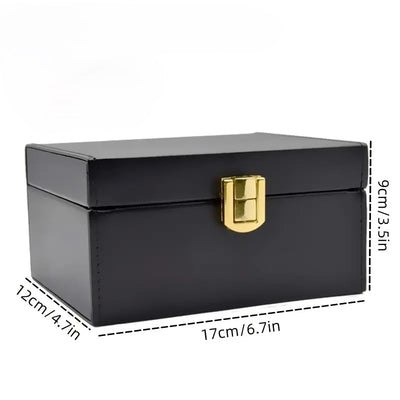
In our Collector Series, we go to great lengths to preserve the woodworking traditions established in the mid-19th century. We don't just replicate the 1849 Staunton pattern; we honour the specific densities and finishes that made those original sets legendary. Owning such a set is an investment in history, which is why we always recommend a fitted casket or a partitioned box for storage. Protecting your handcrafted pieces from UV light and humidity is essential for preventing the wood from checking or cracking over time. If you happen to inherit an antique set that has seen better days, professional restoration is usually the wisest path. Attempting to repair a split in a 100-year-old ebony Knight without the proper tools can lead to irreversible damage.
There is a quiet, meditative joy found in the final hours of chess set woodworking. As you apply the last coat of wax and buff the wood to a soft, silken sheen, you're participating in a craft that spans centuries. It's a slow process that rewards patience and punishes haste. When you finally sit down to play, the smooth texture of the wood and the perfect balance of the pieces remind you that you aren't just playing a game; you're engaging with a legacy of artisan excellence that will likely outlive us all.
Preserving the Integrity of the Royal Game
The journey from a raw block of boxwood to a perfectly weighted Staunton king is one of immense patience and technical rigour. It isn't just about the lathe; it's about understanding how grain responds to a chisel and how a knight's mane must be carved with identical precision across every set produced. This level of chess set woodworking demands a respect for the 1849 standards that few can truly replicate in the modern age. You'll find that the tactile weight of a triple-weighted piece fundamentally changes how you perceive the rhythm of a match.
Since 1993, Official Staunton has acted as a dedicated custodian of these traditions, serving as trusted suppliers to the British Museum and the world's most discerning international collectors. We often find that the most rewarding work lies in our specialist restoration services, where we breathe new life into heirloom sets that have seen decades of strategic battle. It's a privilege to ensure these architectural masterpieces survive for the next generation of grandmasters.
You're invited to explore our exquisite range of handcrafted Staunton pieces and boards to find a set that resonates with your own sense of history. Choosing a set of this calibre ensures that the tactile joy of the game remains as sharp as the tactics employed on the board. We hope you find a piece of heritage that inspires your next great move.
Frequently Asked Questions
What is the best wood for making a chess set?
Boxwood and Ebony remain the gold standard for historical accuracy and durability in the world of fine carving. Boxwood offers a dense, fine grain with a specific gravity of 0.95, while African Ebony provides a natural weight and a density of 1.20. These timbers have been the preferred choice for the Official Staunton pattern since 1849 because they allow for the sharp, crisp detailing required in professional chess set woodworking. You'll find that alternative hardwoods like Rosewood or Padauk also perform well, though they lack the iconic monochromatic contrast of the Victorian originals.
How much does it cost to make a high-quality wooden chess set?
Creating a high-quality set typically requires an investment between £150 and £2,000 depending on your choice of exotic timbers and tools. A single block of premium Grade A Ebony can cost upwards of £80 alone, and when you factor in the 40 to 60 hours of artisan labour required for carving, the value increases significantly. Most hobbyists spend about £300 on initial materials and basic specialised chisels before they even begin the turning process. It's a significant commitment, but the result is a functional heirloom that lasts for generations.
Why is the Knight always the hardest piece to carve in woodworking?
The Knight is the only piece that can't be completed entirely on a lathe, as its anatomical features require meticulous hand-carving. A master carver might spend three hours on a single Knight, executing 25 to 30 precise cuts to define the mane and ears. This departure from rotational symmetry introduces a high risk of error, where a 1mm slip can ruin the entire piece. It's the ultimate test of a woodworker's patience and historical understanding of the Staunton aesthetic, which is why sets are often priced based on the Knight's complexity.
Is it better to turn chess pieces from green wood or seasoned timber?
You should always use seasoned timber with a moisture content between 8% and 10% to ensure the longevity of your set. Turning green wood often leads to heart-breaking results, as the pieces will likely crack or warp as they dry over the following six months. Professional chess set woodworking demands stability, especially for the delicate collars and bases that must remain perfectly circular to fit within their designated squares. It's much better to wait for a kiln-dried blank than to watch your hard work split apart after a few weeks on the board.
What is the standard size for a tournament-grade wooden chess board?
A standard tournament-grade board features squares measuring exactly 55mm, though FIDE regulations allow for a range between 50mm and 65mm. The total playing surface usually spans 440mm to 520mm across, providing ample room for the pieces to breathe during intense play. It's a common rule of thumb that the base of your King should occupy approximately 75% to 80% of the square's width to maintain a balanced and professional appearance. If the squares are too small, the board feels cluttered; if they're too large, the pieces look isolated and diminished.
How do I add weight to my handmade wooden chess pieces?
To achieve that satisfying thud on the board, you should bore a hole in the base of each piece and insert a lead or tungsten slug. A typical weighted King might have 30g of metal added to its core, which lowers the centre of gravity and prevents accidental tipping during a blitz game. Once the weight is secured with epoxy, it's essential to seal the cavity with a disc of wood or a thick layer of billiard cloth felt. This protects the board's surface and ensures the piece feels substantial and premium in the player's hand.
Do I need a specific type of lathe for chess set woodworking?
A standard benchtop wood lathe with at least a 1/2 horsepower motor is perfectly sufficient for turning chess pieces. You don't need a massive industrial machine; instead, focus on a lathe with an 8-inch swing and high-precision bearings to minimise vibration. Using a collet chuck rather than a traditional four-jaw chuck will also help you grip the small timber blanks more securely without marring the delicate wood grain. Precision is more important than power when you're working on something as small as a Pawn or a Bishop's mitre.
How can I prevent my wooden chess board from warping over time?
Preventing a board from warping requires using quarter-sawn timber and ensuring the underside is finished identically to the top. Wood is a living material that reacts to humidity, so a board that's 18mm thick needs a stable substrate or a traditional breadboard end to restrict movement. Another professional trick is to use a veneer technique on a high-quality birch plywood core, which eliminates 90% of the movement associated with solid wood construction. This ensures your playing surface remains perfectly flat, even as the seasons change in your home.
Leave a comment