







Messrs. Miceli & Singh — creators of the world’s finest Jaques-style chess reproductions
Precision, Historical Fidelity and the Revival of Jaques Reproduction Chessmen
A specialist collaboration built around careful study of historic Staunton proportions, traditional materials and the distinctive carving language that gave nineteenth-century Jaques chessmen their enduring character.


Recreating historical character begins with proportion
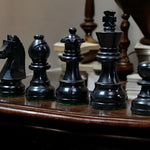
KS Art Works has developed a particular specialism in historically inspired Staunton chessmen, including reproductions based upon important Jaques-style patterns from the formative nineteenth-century period. The objective is not simply to create a chess set that looks old. It is to understand the relationships between height, base diameter, stem, collar, crown and carved detail that give an original pattern its identity.
Working with Official Staunton and Carmelo “Carl” Miceli, designs have been refined through repeated comparison with period examples, reference samples and established historical proportions. The process is one of continual adjustment rather than superficial imitation.
The difference between reproduction and approximation
Many modern chessmen borrow visual cues from nineteenth-century patterns, yet relatively few attempt to reproduce the full relationship between the pieces. Historical accuracy depends on more than the height of the king or the shape of a knight. Base diameter, stem length, collar position, crown mass, pawn scale and the visual spacing of the complete army all contribute to authenticity.
A design may appear convincing when photographed individually yet lose its historical character once placed beside the other pieces. For this reason, development is approached as a complete system. Individual forms are repeatedly compared with the army as a whole until proportion and visual balance work together.
Material selection and craft execution
Fine-grained hardwoods remain fundamental to high-quality chess reproduction. Boxwood provides the clean grain and working characteristics required for precise turning and detailed carving, while ebony and other dense dark timbers create the traditional contrast associated with many historic sets.
Timber is selected not only for appearance but also for its behaviour during turning, carving, polishing and long-term use. Natural grain, colour and density inevitably vary, giving each completed army a degree of individuality.
Studied Profiles
Historic examples and physical references inform height, base geometry, collars and crowns.
Controlled Shaping
Repeatable formation methods establish consistent turned forms while preserving the intended historical proportions.
Human Judgement
Sanding, detailing, polishing and final refinement remain dependent upon skilled hand finishing.
The knight reveals the quality of the reproduction
Within almost every historic Staunton family, the knight carries more individual character than any other piece. The kings, queens, bishops, rooks and pawns are largely governed by turned profiles. The knight introduces sculptural judgement.
Brow, muzzle, ears, mane, jawline and curvature of the neck must work together. Too much exaggeration can make a reproduction theatrical; too little definition removes the character that distinguishes one period pattern from another.
Specialist artisans therefore refine the knight after the main form has been established, concentrating on proportion, expression and surface detail rather than simply creating a generic horse.
It is often the fastest way to identify whether the maker has understood the source pattern. The transition from head to neck, placement of the mane, muzzle length and relationship with the base reveal far more than surface decoration alone.
The role of Carmelo “Carl” Miceli
Carmelo “Carl” Miceli has worked with historically inspired Staunton chessmen for more than two decades through The Official Staunton Chess Company. His involvement in reproduction development has centred on close examination of original patterns, reference examples and the proportional relationships that distinguish different nineteenth- century designs.
Development work with KS Art Works has included refinement of knight profiles, changes to base diameter, adjustments to stem and collar proportions and repeated assessment of the complete army rather than individual pieces in isolation.
This iterative approach is important because historically convincing chessmen rarely emerge from a single prototype. Small dimensional adjustments can change the character of an entire set, particularly once the pieces are arranged together on the board.
Preserving the design language of the early Staunton pattern
The Staunton design introduced in 1849 ultimately became the international visual standard for chess pieces. Its longevity is remarkable because the underlying idea is both decorative and functional: the pieces are immediately recognisable, easy to handle and visually coherent as an army.
Historically informed reproduction allows those qualities to be experienced without the limitations of owning fragile or exceptionally valuable nineteenth-century originals. Modern pieces can be played, handled and displayed while still reflecting the proportions and character that attracted collectors to the historic designs in the first place.
Historical fidelity without turning history into a museum piece
The most successful reproduction is neither an exaggerated antique imitation nor a generic modern Staunton set. It occupies the space between the two: historically informed in proportion and character, carefully produced in natural hardwood and robust enough to be enjoyed as chess equipment.
The continuing collaboration between KS Art Works and Official Staunton is intended to preserve that balance—studying earlier designs closely while producing chessmen for modern collectors and players rather than merely copying their outward appearance.