





The Morphy Series Chess Pieces: A Definitive Guide to Mid-Victorian Artistry
A chess set is frequently judged by the stature of its King, yet the true soul of a mid-Victorian masterpiece resides almost entirely within the expressive, hand-carved features of its Knight. It's a sentiment many serious collectors share, especially when faced with the modern trend of mass-produced sets that often feature crudely finished figures and lack the gravitas required for a serious study. You've likely felt that specific pang of disappointment when a piece feels too light or fails to capture the historical spirit of the 1849 original design.
Owning such a set is about more than just the game; it's about the tactile pleasure of a triple-weighted base and the visual harmony of perfectly proportioned boxwood. We'll examine how The Morphy Series Chess Pieces recreate the specific 1851 design nuances that Paul Morphy himself would've recognised, focusing on the artisan techniques that prevent the common pitfalls of poor balance and historical drift. This journey through the Staunton legacy will reveal why these pieces remain the definitive centrepiece for any sophisticated library or collection in the United Kingdom.
Key Takeaways
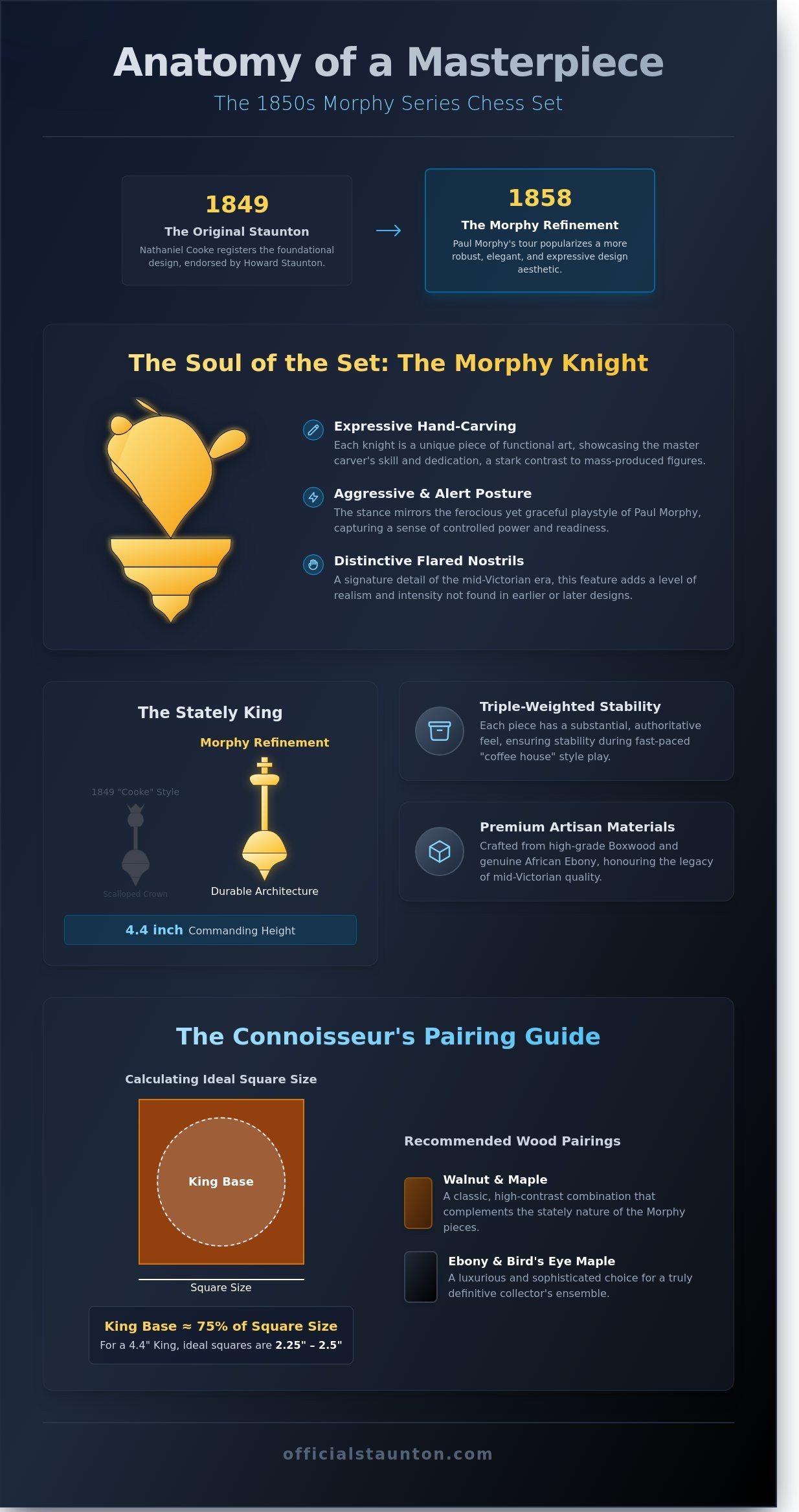
- Trace the historical lineage of the Staunton pattern, discovering how Paul Morphy’s 1858 European tour served as the catalyst for refining the original 1849 design into a more sophisticated aesthetic.
- Learn to distinguish the "Morphy Knight" by its expressive, hand-carved features, a defining element that establishes The Morphy Series Chess Pieces as a pinnacle of Victorian functional art.
- Explore the subtle design evolutions that separate this series from later sets, focusing on the specific silhouettes of the Rook and Bishop that maintain nineteenth-century authenticity.
- Gain the expert knowledge needed to curate a complete ensemble, from calculating the ideal square size for a 4.4-inch King to selecting wood pairings like Walnut and Maple.
- Appreciate the meticulous dedication of master carvers who employ traditional techniques to ensure each set honours the integrity and legacy of the mid-Victorian era.
The Historical Genesis of the Morphy Series Chess Pieces
To understand the enduring allure of The Morphy Series Chess Pieces, one must look back to the precise moment when the game of kings shed its chaotic regional variations for a unified, classical aesthetic. This transformation began on 1st March 1849, when Nathaniel Cooke registered his design for a new style of chessmen. It was Howard Staunton, the era's pre-eminent player, who lent his name and endorsement to the pattern, yet the design reached its zenith during the late 1850s. This period is often described by historians as the "golden age" of chess equipment design, a decade where the initial 1849 concepts were refined into the sophisticated silhouettes we celebrate today.
The evolution from the early "Cooke" style to the mid-Victorian profile was not merely an aesthetic choice; it was a response to the practical needs of a growing global chess community. While the original Staunton chess set established the fundamental shapes of the pieces, the Morphy series introduced a sense of robust elegance that the earlier, more slender versions lacked. By 1855, the craftsmanship of the era's leading artisans had matured, resulting in pieces with slightly broader bases and more intricate carving on the knights. This transition ensured that the sets were not only beautiful to look at but also felt substantial and authoritative during the heat of a match.
Paul Morphy: The Unofficial Champion as Design Muse
The arrival of the American prodigy Paul Morphy in London and Paris in 1858 acted as a massive catalyst for the luxury chess market. Morphy’s play was characterised by a blend of tactical ferocity and effortless grace, a style that many felt was perfectly mirrored in the 1858-1860 Staunton pattern. As Morphy dismantled the European elite, the demand for the specific sets he used soared. Collectors began to seek out pieces that captured that same sense of poise. Manufacturers responded by emphasizing the "Morphy" knight, a piece that stands as a testament to the artisan's skill with its flared nostrils and alert, aggressive posture. It's this connection between Morphy’s intellectual dominance and the physical beauty of the wood that gives the series its soul.
The 1850s Refinement of the Staunton Standard
Distinguishing between early and mid-Victorian patterns is a skill prized by serious connoisseurs. The Morphy series represents the 1850s refinement, moving away from the "scalloped" king's crowns of 1849 toward a more stately and durable architecture. During this decade, the height of the king was often standardised at 3.5 to 4 inches, providing a commanding presence on the board. The use of premium materials like African ebony and high-grade boxwood became the hallmark of the era. Another factor worth considering is the introduction of triple-weighting, which provided the physical stability required for the fast-paced, "coffee house" style of play that was popular in the mid-19th century. You might notice that these pieces feel surprisingly modern in their ergonomics, despite their century-old heritage.
The Morphy Series Chess Pieces are more than mere tools for play; they are historical artefacts that bridge the gap between the Victorian artisan's workshop and the modern grandmaster's study. Every curve of the bishop's mitre and every crenulation of the rook's tower reflects a period when chess was transitioning into a professional pursuit. Owning such a set is an act of preservation, a way to maintain a tangible link to the 1858 tour that changed the game forever. It's a design that has never been surpassed, remaining the definitive expression of what a chess set should be.
The Anatomy of Excellence: Defining Features of the Morphy Pattern
The Morphy pattern isn't merely a set of instructions for a lathe; it represents a specific moment in the mid-19th century when the Staunton design reached its most expressive and regal form. When you hold one of The Morphy Series Chess Pieces, you're feeling the result of nearly two centuries of refinement. The balance is deliberate, and the weight feels substantial yet allows for a certain nimbleness during a rapid game. It's this intersection of heavy engineering and delicate artistry that separates a genuine tribute from a mass-produced imitation. Every curve and bevel is designed to serve the player's hand while satisfying the collector's eye.
The Knight: The Soul of the Morphy Series
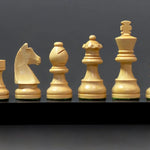
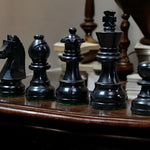
Artisans often say the Knight is where a carver reveals their true soul. In this series, the Knight is a study in controlled aggression. You'll notice the flared nostrils and the way the ears are pricked forward, as if the piece is anticipating the tension of a middle-game sacrifice. This level of detail requires a master's touch that machines simply cannot replicate. While modern manufacturing often relies on CNC assistance to churn out uniform shapes, these pieces are shaped by hand. This process ensures no two Knights are identical, yet both remain perfectly symmetrical in spirit.
The muscularity of the neck and the fine graining of the mane are hallmarks of the mid-Victorian aesthetic. This dedication to historical accuracy is what brings us closer to the era of the "Pride and Sorrow of Chess," and those curious about the original inspirations can view Paul Morphy's personal chess set preserved by the Historic New Orleans Collection. It's a reminder that we aren't just playing a game; we're participating in a living history. If you're looking to elevate your study or club room, you might find that browsing our full collection provides the perfect starting point for your own legacy.
Technical Specifications of the 4.4-Inch King
The King stands at a commanding 4.4 inches, a height that offers a regal presence on a standard 55mm to 60mm square board. Its finial is sharp and well-defined, following the traditional cross pattée style that became the hallmark of the 1849 Cook design. Stability is achieved through a generous base diameter, often exceeding 48mm for the King, which provides a low centre of gravity. This is further enhanced by triple-weighting; a process where lead weights are precisely inserted into the base to give the piece a satisfying "thud" rather than a hollow "clack" when placed on the board.
- Triple-Weighted Stability: Each piece is weighted to ensure it won't tip during the heat of a blitz match.
- Premium Materials: We use genuine Ebony for the dark pieces, providing a natural weight and a deep, lustrous black that develops a unique patina over decades.
- Boxwood Contrast: The light pieces are carved from Grade-A Boxwood, offering a warm, creamy finish that makes the natural grain patterns visible under soft lighting.
- Billiard Cloth Bases: A thick disc of green billiard cloth protects the polished surface of your board, ensuring smooth movement across the squares.
The tactile feedback of The Morphy Series Chess Pieces is perhaps their most overlooked quality. The wood is polished to a fine sheen using natural waxes rather than thick lacquers, allowing the player to feel the organic texture of the timber. This choice reflects our commitment to the standards of the 19th-century workshop, where the goal was to create tools for the mind that felt as good as they looked. You'll find that the weight distribution makes even the smallest Pawn feel significant, encouraging a more thoughtful and deliberate style of play.
Comparing the Morphy Series to Other Iconic Staunton Designs
When placing the 1849 original Staunton design alongside the later Victorian iterations, the differences are subtle yet profound to the trained eye. The earliest sets, commissioned by Nathaniel Cook and endorsed by Howard Staunton, possessed a certain delicate grace that reflected the experimental nature of the period. By the time the design evolved into what we now recognise as the Morphy pattern, around 1851 to 1855, the pieces had gained a more commanding presence. This shift wasn't merely aesthetic; it was a response to the practical needs of players who required more stability during the heat of a match at the London Chess Club or the Divan.
If you look at the Fischer-Spassky 1972 sets used in Reykjavik, the contrast becomes even more apparent. Those 20th-century sets were designed for the television age, featuring blunt, simplified lines that could withstand the rigours of international grandmaster play without the risk of chipping. The Morphy Series Chess Pieces, by comparison, retain the ornate flourishes of the mid-19th century. They offer a level of artistry that the utilitarian 1972 sets simply don't aim for, making them a preferred choice for those who view the chessboard as a stage for historical drama rather than just a field of sport.
The Evolution of the Rook and Bishop
The silhouette of the Rook in the Morphy series marks a departure from the slender, almost fragile stems seen in the 1849 prototypes. These later Rooks feature a more substantial base and a thicker trunk, providing a satisfying weight when you're sliding them across a mahogany board. The crenulations, or the battlements atop the Rook, are carved with deeper, more pronounced grooves than their predecessors. This gives the piece a rugged, architectural quality that feels permanent and unshakeable.
The Bishop also underwent a transformation during this era. While the 1849 Bishop often featured a shallower mitre, the Morphy Bishop showcases a deep, clean mitre cut that is both elegant and sharp. This specific detail is a hallmark of Official Staunton craftsmanship, where the angle of the cut is executed with mathematical precision to ensure symmetry. The transition from the bulbous head to the slender neck is more fluid in this series, creating a piece that feels balanced in the hand and looks exceptionally graceful on the square.
Choosing Your Series: A Collector’s Dilemma
Many enthusiasts find themselves torn between the "Collector" series and the Morphy series. The modern Collector series is often a 1990s interpretation of the Staunton form, focusing on extreme weighting and oversized proportions. While impressive, it lacks the historical soul found in the Morphy pattern. The Morphy Series Chess Pieces are built for the connoisseur who values authenticity, as they mirror the exact equipment Paul Morphy would have used during his 1858 tour of Europe. Choosing this set is about more than just owning a game; it's about connecting with a specific moment in chess history when the game was transitioning into its modern professional form.
You might wonder if such a specialised set is worth the investment for a casual home player. While a standard boxwood set might cost £50, a high-quality Morphy reproduction often ranges from £350 to £600 depending on the wood choice, such as Ebony or Boxwood. This price reflects the hundreds of hours of artisan labour required to hand-carve each Knight. For the casual player, the value lies in the tactile experience. There is a distinct rhythm to a game played with triple-weighted, felted pieces that you simply cannot replicate with plastic or low-grade timber. It changes the way you think about your moves, encouraging a slower, more deliberate pace of play.
Owning a set of this calibre is akin to owning a piece of fine furniture or a classic timepiece. It doesn't just sit on a shelf; it matures with age, developing a rich patina that tells the story of every game played. For the serious collector, the Morphy series isn't just an option; it's a foundational requirement for any curated cabinet. It represents the pinnacle of Victorian design, where function and form met in a perfect, lasting marriage that still dictates our visual understanding of the game today.
Curating the Connoisseur’s Set: Boards and Wood Pairings
Selecting a world-class set of chessmen is only half the journey; the stage upon which they perform is equally vital. When you invest in a set as historically significant as The Morphy Series Chess Pieces, the choice of board becomes a matter of architectural balance. It's not just about finding a flat surface; it's about ensuring the physical presence of the 4.4-inch King is respected by the geometry of the squares. A mismatch here can ruin the visual gravity of the entire display, making a grand set look either cramped or strangely diminished.
Calculating the Ideal Square Size
Professional standards suggest that the base of the King should occupy approximately 75% to 80% of the square's width. For the 112mm (4.4-inch) King found in this series, which typically features a robust base diameter, a board with 55mm to 60mm squares is the absolute benchmark. If you opt for anything smaller, the pieces will feel suffocated during the complex congestion of the middlegame. Conversely, squares exceeding 60mm can make the pieces look isolated, breaking the cohesive "army" aesthetic that defines the Staunton silhouette. It's a delicate balance that ensures the pieces have enough "air" around them to be admired individually while remaining part of a unified tactical landscape.
Selecting the Right Wood Board
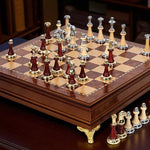
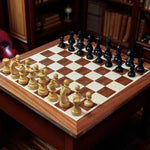
The material of the board should either harmonise with or provide a deliberate contrast to the woods used in your chessmen. If you've chosen a set in Ebony and Boxwood, a board of Macassar Ebony and Maple creates a striking, monochromatic look that feels both modern and deeply traditional. This high-contrast pairing ensures that every detail of the hand-carved Knights is visible, even in lower light. For those who prefer a softer, more evocative Victorian aesthetic, Walnut and Maple boards offer a warm, honey-toned palette that feels right at home in a private library or study.
Another aspect to weigh is the construction of the board itself. While solid wood boards are often prized for their sheer mass and heirloom potential, a high-quality veneer board on a stable MDF core is often more resistant to the warping caused by the UK's fluctuating humidity. You'll want to look for a satin finish rather than a high-gloss one. A mirror-like shine might look impressive in a photograph, but it creates distracting glares during a long match, whereas a satin sheen allows the natural lustre of the wood grain to speak for itself without straining the eyes.
Visibility is the silent partner of successful play. If the wood grain of the board is too "busy" or aggressive, it can swallow the outlines of the pieces, leading to those frustrating moments where you simply overlook a Bishop lurking on a long diagonal. The Morphy Series Chess Pieces deserve a backdrop that provides clarity. A clean, straight-grained Maple for the light squares is almost always the superior choice for maintaining focus during a tense game.
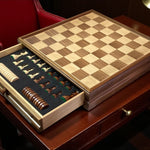
Once you've paired your set with the perfect board, the final step in curation is protection. A set of this calibre isn't something you simply toss into a drawer. A fitted, baize-lined mahogany or oak box is essential for preserving the delicate carvings and the weighted stability of the pieces for the next generation. These boxes often retail between £70 and £150, but they're a small price to pay for safeguarding an investment that will likely outlive its owner. To find the perfect foundation for your collection, you can browse our range of artisan chess boards and find a match that does justice to your set.
Choosing the right pairing is ultimately an act of personal expression. Whether you prefer the stark authority of Ebony or the inviting warmth of Walnut, the goal is to create a tactile experience that invites you to sit down, slow down, and engage with the game. When the proportions are right and the materials sing in harmony, the act of moving a piece becomes more than a tactical decision; it becomes a moment of genuine aesthetic pleasure.
The Official Staunton Commitment to the Morphy Legacy
Official Staunton does not merely manufacture chess sets; we act as the dedicated custodians of a design language that reached its zenith in the mid-19th century. Our approach to historical restoration involves a meticulous study of original 1851 patterns, ensuring that every curve of the Rook and every crenulation of the Queen’s coronet remains faithful to the Victorian aesthetic. We recognize that The Morphy Series Chess Pieces are more than just gaming equipment. They represent a specific cultural moment when the intellectual rigor of chess met the height of British artisan craftsmanship. By maintaining an exclusive network of master carvers who have spent decades perfecting the 1850s style, we ensure that the soul of the original Staunton design is never lost to modern mass-production techniques.
Collectors often turn to us because they require an authenticity that goes beyond surface-level imitation. Our artisans utilize traditional hand-turning methods, a process that requires significantly more time but results in a level of detail that machines cannot replicate. For example, the knights in this series are hand-carved to mirror the distinct, spirited expression of the 1851 originals, a task that takes a senior carver approximately six hours per piece. This commitment to historical accuracy is why Official Staunton remains the trusted choice for serious collectors who view their sets as both a competitive tool and a significant historical record.
The Master Craftsman’s Touch
Quality control at Official Staunton is an exhaustive process where we reject approximately 12% of finished pieces to ensure only the most flawless examples reach our clients. We source our premium Boxwood and Ebony from ethically managed forests, selecting only the densest heartwood to ensure the longevity of the set. When you hold these pieces, the difference is immediate. The triple-weighting system provides a low centre of gravity that offers a satisfying "thud" on a wooden board, a tactile experience that mass-produced plastic or resin sets simply cannot offer. The wood is polished using natural waxes rather than thick lacquers, allowing the organic grain to breathe and develop a rich patina over the coming decades.
A Legacy Beyond the Board
Investing in a high-quality wooden set is a decision that looks toward the future as much as it honours the past. In many British homes, these sets transition from the study to the living room, serving as pieces of functional art that complement sophisticated interior design. There is a profound emotional weight in knowing that the set you use today will likely be used by your grandchildren in fifty years. The durability of Grade-A Ebony ensures that these pieces are generational heirlooms, capable of weathering thousands of games without losing their structural integrity or aesthetic charm.
Choosing The Morphy Series Chess Pieces is an act of preservation. It connects the modern player to the era of Paul Morphy and the original Staunton masters through the simple, physical act of moving a piece across a board. As digital screens continue to dominate our leisure time, the tactile reality of a hand-carved wooden set offers a necessary return to slow, deliberate thought. This series serves as a bridge across time, providing a tangible link to the heritage of the game while remaining a robust tool for the grandmasters of tomorrow. The weight of the wood and the precision of the carve remind us that some things are worth doing with patience and reverence.
Preserving the Spirit of the 1850s Golden Age
Investing in this collection is far more than a simple purchase; it's an act of stewardship over a design that has captivated players since Paul Morphy's mid-Victorian dominance. When you handle The Morphy Series Chess Pieces, you're interacting with a legacy of form and function that remains as relevant today as it was in 1849. These sets are hand-carved by master artisans who meticulously recreate the distinctive, soulful knight that defines this specific pattern. Because they're triple-weighted for superior balance, each move carries a deliberate weight and authority that lighter, contemporary sets simply can't replicate.
The presence of the Official Staunton Seal of Authenticity ensures your collection meets the exacting standards expected by the world's most discerning connoisseurs. It's about the quiet satisfaction of knowing every detail, from the felted bases to the polished finish, honours the craftsmanship of the past. Choosing the right board to accompany such artistry is the final step in creating a sanctuary for thought and strategy within your home. We invite you to bring this historical narrative to your own study and experience the tactile brilliance of a true masterpiece.
Explore the exquisite Morphy Series at Official Staunton
Frequently Asked Questions
What makes the Morphy Series different from a standard Staunton set?
The Morphy Series Chess Pieces distinguish themselves through a faithful adherence to the 1851 Cooke design, specifically featuring a more robust, wider base than modern utilitarian sets. While a standard Staunton set often simplifies the collar and crenulations for mass production, this series retains the delicate swan neck profile of the knight and the sharp, distinct points of the Queen's coronet. It's a design that prioritises the aesthetic weight of the mid-Victorian era, ensuring each piece feels substantial and historically accurate during play.
Why is the Knight so important in the Morphy Series design?
The Knight serves as the artistic soul of the Morphy Series, hand-carved to replicate the fierce, expressive features found in the early 1850s originals. Unlike the uniform, machine-finished knights in cheaper sets, these pieces feature a distinctively flared mane and a focused, downward gaze that reflects the intensity of a grandmaster's calculation. Each Knight requires approximately 4 hours of individual carving by a master artisan to ensure that the musculature and facial expression align with the heritage of the 1849 pattern.
What size chess board should I use with Morphy Series pieces?
You should pair these pieces with a board featuring square sizes of at least 55mm, though a 60mm square often provides a more breathable, luxurious aesthetic. Since the King in this series typically possesses a base diameter of 44mm, a 55mm square ensures that the pieces occupy roughly 78 percent of the available space, which is the gold standard for visual clarity. Choosing a smaller board can make the battlefield feel cluttered, detracting from the sweeping lines and architectural elegance of the boxwood and ebony.
Are the Morphy Series chess pieces suitable for tournament play?
These pieces are entirely suitable for competitive play, as they strictly adhere to the proportions and silhouette requirements established by FIDE and the English Chess Federation. While their artistry might suggest they belong behind glass, the triple-weighted foundations and felted bases provide the stability required for high-stakes matches. Many collectors find that the tactile feedback of the premium ebony actually enhances their focus during a long game, making them a practical choice for the serious club player.
How do I care for my Boxwood and Ebony chess pieces?
Protecting your investment requires maintaining a stable environment, ideally keeping the set away from direct heat sources like radiators or sunlight. Ebony is a dense, natural material that can develop hairline fractures if the humidity drops below 40 percent, so a consistent room temperature is vital. A light application of high-quality Renaissance wax once every 12 months will preserve the lustre of the grain without leaving the sticky residue often found with cheaper furniture polishes.
Is the Morphy Series weighted for blitz chess?
Every piece in the Morphy Series is triple-weighted with lead or steel inserts, giving the King a formidable weight of approximately 75 grams for a 4-inch model. This internal ballast ensures that the pieces remain upright even during the frantic time scrambles of a 3-minute blitz game. You'll find that the low centre of gravity prevents the tipping common in hollow plastic sets, allowing you to move with confidence when the clock is ticking down to those final seconds.
What is the history behind the name Morphy Series?
The name pays homage to Paul Morphy, the American prodigy who dominated the European chess scene during his historic 1858 tour of London and Paris. It was during this mid-Victorian golden age that the Staunton design became the universal standard, and Morphy himself was famously presented with a similar exquisite set at the Manhattan Chess Club. By naming this series after him, Official Staunton honours the era when chess transitioned from a casual pastime into a rigorous, professional pursuit.
Can I buy replacement pieces if one gets lost or damaged?
Official Staunton maintains a dedicated archive of spare pieces, so you can easily secure a replacement should a pawn go missing or a knight suffer a fall. Because these pieces are hand-carved from natural timber, the grain and carving details can vary slightly, but the craftsmen work to match the patina of your existing set as closely as possible. It's a sensible precaution to contact the workshop directly with a photograph of your set to ensure the new piece integrates seamlessly with your original 32.
The enduring appeal of these pieces lies not just in their physical weight, but in the historical gravity they bring to the board. When you handle a piece from the Morphy Series, you're touching a design that has witnessed the evolution of modern theory and the rise of the world's greatest players. It's this connection to the past, combined with uncompromising Victorian craftsmanship, that transforms a simple game into a profound experience of heritage and art.
Leave a comment