





Does the Type of Wood Really Matter When Buying a Chess Set?
Does the Type of Wood Really Matter When Buying a Chess Set?
Hardwood, softwood, ebony, boxwood, acacia and veneers can sound confusing. Here is what actually matters when you are choosing a set to play with and keep.
Customers often ask us which wood makes the best chess set. It sounds like a simple question, but there is no single timber that wins in every situation.
A set for a family kitchen table has different demands from a reproduction bought by a collector. A folding board has different structural requirements from a large inlaid board. A tournament player may care more about stability and clear contrast than an exotic wood name.
There is also a great deal of confusing language around timber. “Hardwood” is regularly treated as another word for hard, expensive or luxurious. “Softwood” is assumed to mean cheap and weak. Botanically, neither description works that way. Hardwood comes from angiosperm trees, generally broad-leaved flowering species, while softwood comes from gymnosperms such as conifers. Some hardwoods are relatively soft and some softwoods are surprisingly strong.
For chess equipment, the useful questions are more practical. Is the timber stable? Does it turn cleanly? Can it hold fine detail? How dense is it? How does it take a polish or stain? Is it suitable for the particular component being made?
Those questions tell you much more about a chess set than the word “hardwood” printed on a product page.
Stability
Good chess timber needs to behave predictably as normal humidity changes.
Detail
Fine, close-grained woods are well suited to turning and carved knight work.
Density
The wood itself contributes to the weight and feel of every piece.
Appearance
Colour, grain and finish affect the character of the finished set.
First, What Is the Difference Between Hardwood and Softwood?
The names are botanical classifications, not a reliable hardness scale.
Hardwoods come from flowering plants that produce seeds with some form of covering, such as fruit or a nut. Oak, maple, walnut, boxwood and ebony are examples of hardwoods.
Softwoods come mainly from conifers. Pine, spruce, cedar and fir are familiar examples.
In everyday woodworking, many common softwoods are indeed softer and lighter than the dense hardwoods used for fine chess pieces. That is why the everyday meaning of the words seems to make sense. But it is not a rule of nature.
Balsa, for example, is botanically a hardwood despite being exceptionally light. Yew is a softwood botanically, yet its timber can be relatively hard and durable.
So is hardwood automatically better?
No. For traditional turned chessmen, suitable hardwoods are usually preferred because their density, grain and working qualities suit the job extremely well. But the quality of the timber and the way it is used matter more than the category name on its own.
Why Boxwood Became Such an Important Chess Wood
If there is one timber closely associated with traditional Staunton chessmen, it is boxwood.
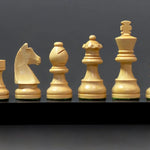
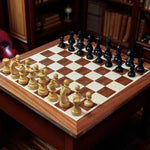
Boxwood has a very fine, even texture. It can be turned cleanly, accepts detailed work and produces the smooth curves needed for collars, bases, crowns and finials. Its pale natural colour also makes it an obvious choice for the light army.
It has another useful characteristic: it can be stained. Ebonised boxwood uses a dark finish to give the appearance of ebony while retaining the working properties of boxwood. Antiqued finishes can create warmer, aged tones.
Boxwood is not chosen simply because it is pale. It is a practical carving and turning timber that has proved itself over generations of chess manufacture.
When customers handle good boxwood pieces, they often notice how smooth the turned surfaces feel. That comes partly from finishing, but the close grain of the wood provides an excellent foundation.
The most famous chess woods became established for practical reasons as well as appearance. Craftsmen repeatedly used materials that turned cleanly, held detail and produced dependable pieces.
What Does Ebony Add?
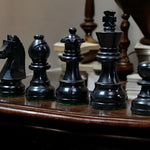
Ebony has become closely associated with premium chessmen because of its naturally dark colour, density and ability to take a fine finish.
A polished ebony king has a particular presence. It feels substantial before any additional weighting is considered, and the contrast against natural boxwood is unmistakable.
Natural ebony is not necessarily an absolutely uniform jet black. Depending on the species and individual piece of timber, it can show brown or lighter streaks. That is part of the material rather than evidence that the piece is inferior.
Density also brings considerations. Very dense woods can react to abrupt changes in humidity and temperature. Correct seasoning, sensible construction and normal household care therefore remain important.
Ebony is not required to make a good chess set. It is a premium material with a distinctive appearance and feel. A well-made ebonised boxwood or acacia set can be a better purchase for someone who wants a practical playing set rather than the character of natural ebony.
What About Acacia, Rosewood and Other Dark Woods?
Different hardwoods allow chess sets to have very different personalities without changing the basic Staunton design.
Acacia is popular because it offers warm brown colour and visible grain. It works particularly well in sets intended to feel less formal than ebony while still retaining the look of quality wooden chessmen.
Woods sold historically or commercially under rosewood-related names can provide deeper reds and browns with attractive figuring. Precise botanical identification matters, however, because common trade names are not always consistent and some Dalbergia species are subject to international trade controls.
Sheesham has also been widely used for chess equipment. It has an attractive brown appearance and is common in boards and pieces produced in India.
The important point for the buyer is that colour alone does not determine quality. A less expensive wood can be beautifully selected and finished. An expensive timber can be badly worked.
Choose by appearance if you want
- The deep formality of ebony
- The warm grain of acacia
- The clean traditional look of boxwood
- An aged appearance from antiqued finishes
- A board that complements existing furniture
Choose by use if you need
- A durable everyday playing set
- A historically faithful reproduction
- A set suitable for frequent transport
- A particular weight and handling feel
- A lower-maintenance finish
Does Denser Wood Make Better Chess Pieces?
Not automatically.
Density changes how a piece feels. A naturally dense timber contributes more mass than a lighter timber of the same dimensions. That can make a piece feel substantial and can influence the amount of additional weighting required in the base.
But weight alone is not quality. A chess piece also needs good proportions, a stable base, accurate turning, clean finishing and appropriate weighting.
There is a point at which making a piece heavier adds little. An excessively heavy chessman can feel cumbersome, particularly during quick play. It may also place unnecessary stress around a badly designed weighted cavity.
We therefore judge timber as part of the complete design. The wood, dimensions and internal weight need to work together.
Why Grain Matters to Chess Makers
Grain is more than decoration.
The direction and consistency of the fibres affect how timber cuts. Fine, even grain allows crisp turning and helps carved details retain their shape. Irregular grain can require more care during formation and hand finishing.
This becomes particularly important with knights. A knight contains projecting details and changes of direction that a simple turned pawn does not. The blank must support those details without tearing or breaking away.
Grain also affects the final appearance. A heavily figured timber can look wonderful on a broad board square or rook body, while the same dramatic grain might compete visually with very intricate carving.
There is no universal “best” grain. The maker has to match the timber to the design.
Are Softwoods Used for Chess Sets?
Yes, although they are less common in fine traditional chessmen.
Pine and similar woods can be used for inexpensive boards, boxes, decorative sets and larger rustic pieces. They are easy to work and relatively light.
For finely turned Staunton chessmen, however, softer open-grained woods are generally less suitable than close-grained hardwoods. Fine collars, narrow stems and carved details benefit from a timber that can hold a crisp edge.
Softwoods can also dent more readily in normal use, depending on the species.
That does not make a softwood chess set inherently bad. A simple pine set can be charming and entirely fit for purpose. It simply belongs to a different category from a finely turned boxwood and ebony reproduction.
Solid Wood or Veneer: Which Is Better for a Chess Board?
This is another area where buyers are often given an oversimplified answer.
A veneered board is not automatically a cheap board. Veneer is a thin layer of real wood applied over a stable substrate or core. Used properly, it allows attractive and sometimes expensive timbers to be used efficiently while helping the board remain dimensionally stable.
A large panel made entirely from solid wood naturally expands and contracts across its grain. Good furniture makers design around that movement. A chess board creates an additional challenge because the alternating squares must remain flat and aligned.
High-quality veneer construction can therefore be an excellent solution. The visible surface is genuine wood, while the engineered core provides stability.
Solid boards have their own appeal, particularly where traditional construction is part of the design. The important issue is not whether a board is solid or veneered, but how well the construction has been executed.
| Material or construction | Strength | Consideration | Well suited to |
|---|---|---|---|
| Boxwood pieces | Fine grain, excellent turning qualities | Natural tone varies slightly | Traditional light chessmen |
| Ebony pieces | Dense, dark and highly distinctive | Premium cost; benefits from stable conditions | Luxury and collector sets |
| Acacia pieces | Warm colour and visible natural grain | More tonal variation than ebony | Home playing sets |
| Ebonised boxwood | Classic dark appearance with boxwood base material | Stain quality matters | Practical traditional sets |
| Veneered board | Efficient use of decorative timber and good stability | Core and bonding quality matter | Quality inlaid boards |
| Solid wood board | Traditional material character | Construction must allow for wood movement | Specialist and furniture-style boards |
Does a More Expensive Wood Mean a Better Chess Set?
This is probably the most useful question in the whole article.
No. It can mean a more expensive chess set, but not necessarily a better one for you.
Ebony costs more than ebonised boxwood for reasons connected with the raw material, supply, working characteristics and appearance. That does not mean an ebony set plays chess better.
If you love the depth and feel of natural ebony, the additional cost may be worthwhile every time you set the board up. If your priority is an attractive set for regular family games, you may get more value from a less expensive timber and spend the difference on a larger or better board.
Collectors may place greater value on historically appropriate materials. A reproduction of an important nineteenth-century pattern can feel more convincing when the wood choice reflects the character of the original.
There is no contradiction here. “Best” changes with the buyer.
Pay for the timber because you value what that timber adds — its appearance, feel, historical relevance or rarity — not because an exotic name automatically guarantees better craftsmanship.
What Makes a Wood Suitable for Historic Reproductions?
Reproduction work introduces another consideration: historical character.
The original Staunton chessmen were not designed in a world with today's enormous choice of stains, composites and synthetic materials. Timber choice contributed to their appearance and handling.
When we reproduce historic patterns at Official Staunton, we look at more than the outline of the knight. Proportions, base shape, finish, weighting and wood all influence whether the finished set feels convincing.
Modern pantograph-guided formation cutters allow us to retain the master profile of complex knights with a high degree of consistency. Traditional turning and hand finishing then complete the pieces. The timber has to be capable of carrying that detail.
This is one reason close-grained hardwoods remain so important. Technology can improve repeatability, but it cannot make unsuitable timber behave like a fine carving wood.
What About Sustainability and Timber Restrictions?
Responsible timber sourcing matters increasingly to both makers and buyers.
Some tropical timbers are protected or controlled because of pressure on wild populations. International trade in certain species can be regulated under CITES, and rules can change over time.
This is another reason buyers should be wary of vague exotic-wood claims. A trustworthy product description should identify materials carefully rather than simply attaching a prestigious name to any dark timber.
Alternative woods and high-quality stained finishes can also make excellent chess sets. Using a different timber is not necessarily a reduction in craftsmanship.
For most customers, the sensible approach is to buy from an established retailer that understands its supply chain and describes products accurately.
How Should You Choose the Wood for Your Chess Set?
Start with where and how you will use it.
If the set will live permanently in a sitting room, appearance may be your first concern. Think about the furniture, the board and whether you prefer strong black-and-cream contrast or warmer brown tones.
If it will be played every day, durability and easy handling may matter more than rarity.
If you are buying a historic reproduction, the relationship between material and period design becomes more important.
If it is a gift, a classic combination such as natural boxwood with ebony or ebonised boxwood is easy to understand and unlikely to date.
Then look at the rest of the specification. King height, base diameter, weighting and board-square size will affect daily enjoyment at least as much as the wood species.
Spend more on timber when
- You genuinely value natural ebony or another premium wood
- The set is intended as a collector piece
- Historical material choice matters to the reproduction
- The chess set will remain on permanent display
- You want the tactile feel of a denser natural timber
Prioritise other features when
- Your main aim is everyday play
- You have a fixed overall budget
- A better-sized board would improve the set more
- The set will travel regularly
- Easy replacement and practicality matter most
How to Spot Good Wooden Chess Pieces
You do not need to be a timber expert.
Look at the turning. Curves should flow cleanly. Matching pieces should have consistent proportions. Knights should follow the same overall profile while retaining the small natural differences expected from hand finishing.
Check the bases. They should sit flat. Felt should be neat. Weighted pieces should not rattle.
Look at the finish in good light. Natural grain is welcome; rough sanding, obvious filler, unstable cracks and careless staining are not.
Finally, consider the set as a whole. A good chess set feels coherent. The wood, weight, proportions and board all make sense together.
Frequently Asked Questions
Is hardwood better than softwood for chess pieces?
What is the best wood for chess pieces?
Why is boxwood used for chess pieces?
Is ebony worth paying more for?
Is ebonised boxwood fake ebony?
Is a veneered chess board real wood?
Is solid wood always better than veneer?
Why do wooden chess pieces vary in colour?
Does heavier wood make a better chess piece?
What wood is best for a first quality chess set?
Do expensive woods need more care?
Should I choose the pieces before the board?
Choose the Set, Not Just the Wood Name
Timber matters. It changes colour, grain, weight, feel and sometimes historical authenticity. But it is only one part of a good chess set.
The best choice is the combination of wood, craftsmanship, proportions and board that suits the way you actually want to play and own the set.
Browse Chess SetsBrowse Chess PiecesBrowse Chess Boards
Leave a comment