


The New Pattern
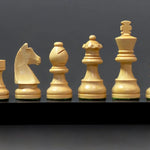
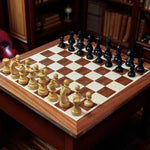
Practical symbolism, broad bases and a disciplined silhouette establish the essential Staunton family.


Historically inspired Victorian Staunton chessmen, recreated for collectors, serious players and those who appreciate the design that changed chess forever.

Introduced in the middle of the nineteenth century, the Staunton pattern gave chess a clear and practical visual identity. Its restrained king, coroneted queen, mitred bishop, recognisable knight and fortified rook formed a family of pieces that could be read immediately across the board.
The design became closely associated with Jaques of London and Howard Staunton. Its success did not rest on ornament alone: the pieces were elegant, stable and unusually legible in play.
Our vintage collection revisits important early interpretations of that design. These are modern reproductions rather than original antiques, created for collectors and players who want historical character in a set that can be displayed, handled and enjoyed.
Early Staunton patterns were never completely static. Profiles, knight carving, crowns, collars and proportions developed across makers, production periods and individual examples. That variation remains part of their fascination.
Practical symbolism, broad bases and a disciplined silhouette establish the essential Staunton family.
Tall stems, elegant collars and expressive knights create the character prized by collectors.
Nathaniel Cooke’s association with the registered design remains central to the story.
Leuchars-linked interpretations contribute distinctive proportions and presentation.
The Staunton design becomes the dominant reference for serious chess play.

A simple spherical head and compact body establish the scale of the army.
The tallest piece, crowned by the instantly recognisable cross finial.
A coroneted crown and elegant stem create a lighter counterpoint to the king.
The mitre cut gives immediate recognition while preserving a graceful vertical form.
The sculpted piece and often the clearest indicator of reproduction character.
A strong turret form anchors the back rank with architectural authority.
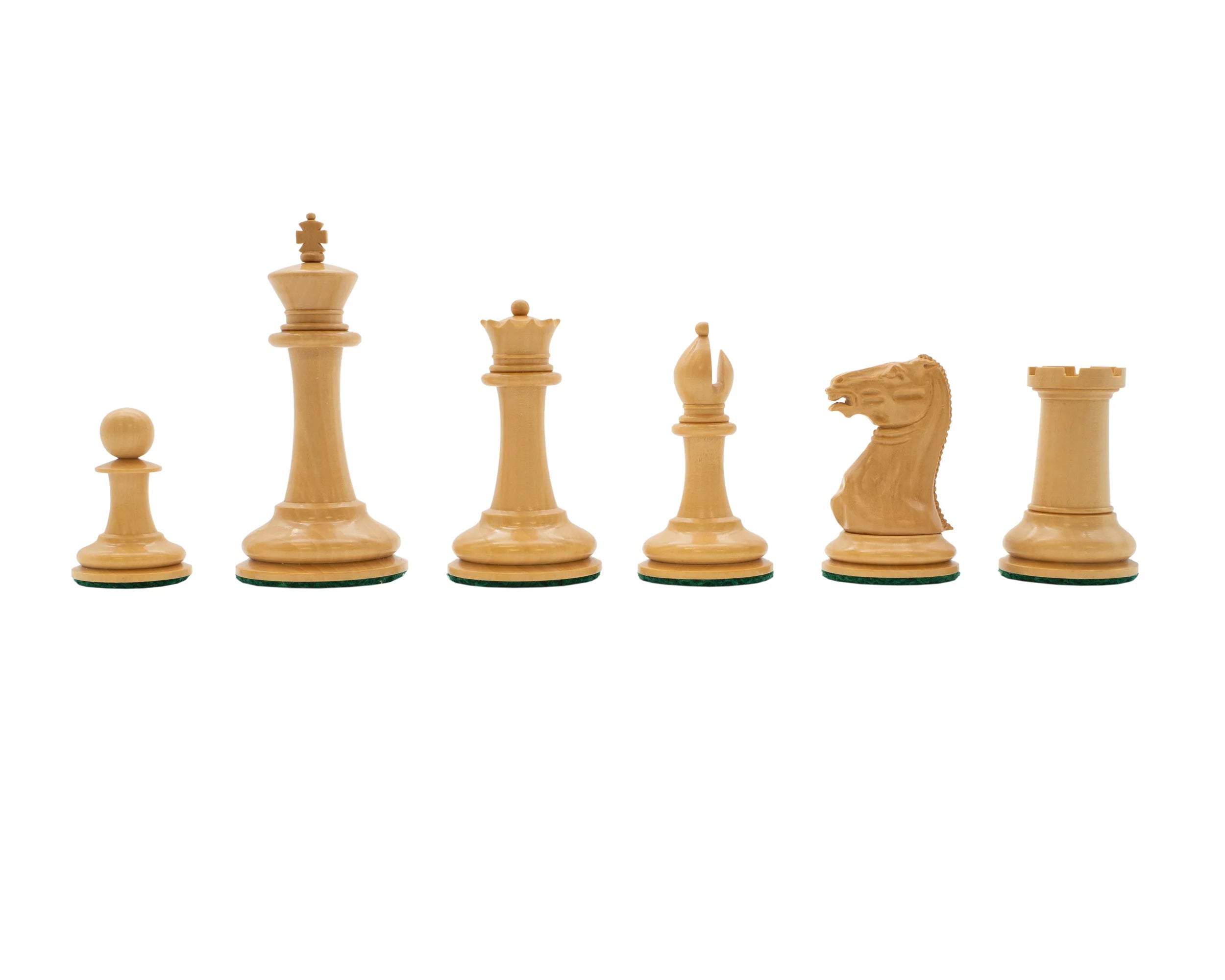
Turned pieces can be controlled through their profiles, but the knight requires sculptural judgement. Brow, muzzle, mouth, ears, mane and stance determine whether the result feels restrained, alert, powerful or theatrical.
Our historical reproductions use pantograph-assisted formation cutters where appropriate to transfer established reference forms consistently. Knights are then hand-crafted and hand-finished, preserving the judgement needed for expression and final surface quality.
Timber is never visually uniform. Differences in grain, shade and figuring give each set a degree of individuality that imitation materials cannot reproduce.
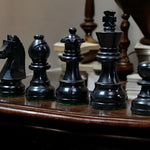
Dense, dark and highly polished, creating dramatic traditional contrast.
Fine-grained and pale, long favoured for detailed turning and carving.
A warmer finish that evokes the mellow tone associated with older chessmen.
Rich red-brown colouring brings depth to luxury boards and combinations.
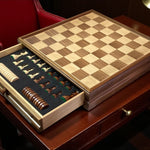
A classic material for polished storage boxes and traditional presentation.
Historic examples, physical samples and documented proportions inform each reproduction.
Formation cutters help establish repeatable turned profiles and period proportions.
Knights and detailed surfaces are refined by hand where judgement matters most.
Selected pieces are weighted, felted, polished and inspected before completion.


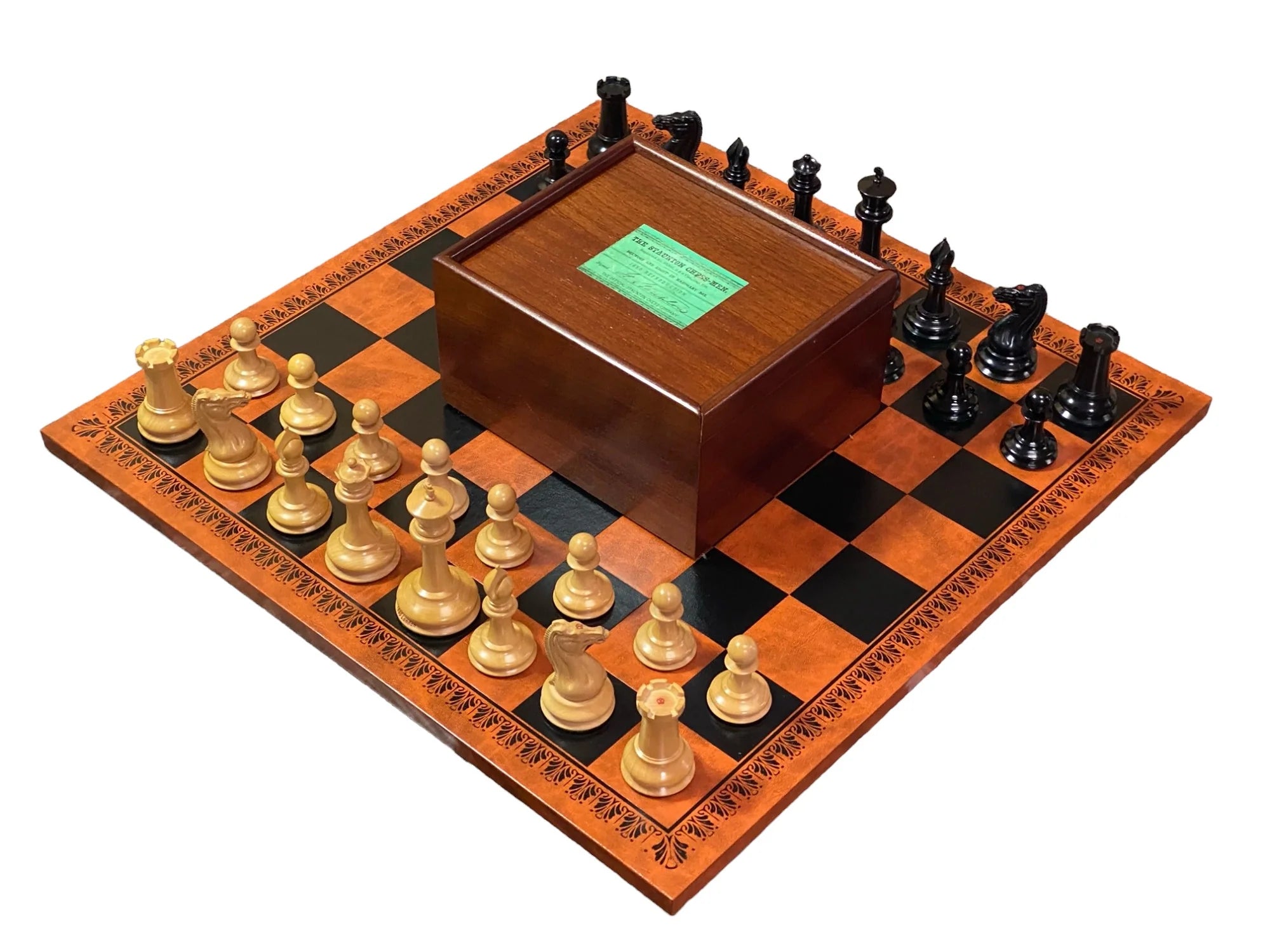
A historically focused reproduction with elegant stems, traditional presentation and a practical collector-friendly scale.
Explore the collection →An expressive interpretation for collectors drawn to nineteenth-century forms and polished mahogany presentation.
Explore the collection →
Mellow antiqued tones and strong silhouettes for traditional studies, libraries and games rooms.
Explore the collection →
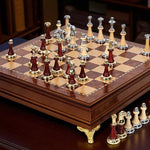
For a room where the chess set is intended to become a permanent feature, scale makes a decisive difference. This substantial combination pairs genuine ebony and antiqued boxwood chessmen with a polished mahogany box and a large luxury board.
These answers explain the distinction between original antiques, historically inspired reproductions and modern playing sets.
Explore historically inspired Staunton chessmen, complete collector combinations and distinctive Victorian reproductions selected for beauty, character and lasting enjoyment.