





The Official Staunton Chess Knowledge Centre
The Complete Guide to Choosing a Chess Set
A clear, practical guide to understanding chess pieces, chess boards, materials, weighting, sizing and craftsmanship before choosing the right set for play, display or collecting.
What makes a good chess set?
A good chess set combines clear piece design, correct board proportion, stable weighting, durable materials and a comfortable playing feel. The best choice depends on how the set will be used: tournament play, home display, study, travel, gifting or collecting.
Piece Size
The king height and base diameter should suit the board square size. Poor proportions can make a set feel cramped or too sparse.
Board Match
The correct board is just as important as the pieces. A well-matched board improves both appearance and playability.
Weighting
Weighted pieces feel more stable in the hand and are less likely to tip during normal play.
Material
Boxwood, ebony, acacia, rosewood and walnut each offer different colour, density, grain and long-term character.
1. Start with how the chess set will be used
The best chess set is not always the most expensive one. The right choice depends on purpose. A tournament player may need regulation proportions, durability and easy piece recognition. A collector may value historical accuracy, fine carving and rare materials. A family buyer may prefer a practical wooden set that looks attractive but can withstand regular use.
| Purpose | Best Choice | What Matters Most |
|---|---|---|
| Regular home play | Wooden Staunton set with a matching board | Durability, balance, clear design and value |
| Tournament or club play | Staunton pieces with suitable board proportions | Recognisable shapes, stable pieces and correct sizing |
| Luxury display | Ebony, rosewood or premium hardwood set | Finish, grain, polish and visual presence |
| Gift purchase | Complete chess set with board and storage | Presentation, practicality and broad appeal |
| Historical interest | Staunton reproduction set | Accuracy, provenance, design research and craftsmanship |
2. Understand chess piece size
Chess piece size is usually described by the height of the king. Common king heights include 3 inches, 3.25 inches, 3.5 inches, 3.75 inches and 4 inches. Larger pieces create a more impressive display, while slightly smaller pieces can be easier to store and handle.
| King Height | Typical Use | Suggested Board Style |
|---|---|---|
| 3 inches | Compact home play, study or travel-style sets | Smaller wooden board or folding set |
| 3.25 inches | Home use and casual play | Medium board |
| 3.5 inches | Club-style play and classic home sets | Standard medium-to-large board |
| 3.75 inches | Tournament-style and premium home play | Larger board with comfortable spacing |
| 4 inches | Luxury display and large-format play | Large board with generous square size |
3. Why weighting matters
Weighted chess pieces are designed to feel more stable and substantial. The added weight is usually placed low inside the base, helping to lower the centre of gravity. This makes the pieces less prone to tipping and gives them a more confident feel during play.
Better Stability
Weighted pieces are less likely to fall over during normal movement across the board.
Improved Feel
A properly weighted piece feels more substantial and controlled in the hand.
Better Balance
The best pieces combine weight with correct shaping, not weight alone.
Premium Impression
Weighting is one of the qualities buyers often notice immediately when comparing sets.
4. Choosing the right material
The wood used in a chess set affects appearance, feel, durability and price. Some woods are chosen for their rich colour, others for their fine grain, density or traditional association with quality chess equipment.
| Material | Appearance | Typical Benefit |
|---|---|---|
| Boxwood | Pale cream to light yellow | Traditional light-side chess wood, smooth and reliable |
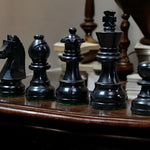
| Ebony | Deep black, dense and premium | Luxury appearance and substantial feel |
| Ebonised boxwood | Boxwood dyed black | Classic black look at a more accessible price |
| Acacia | Warm brown with natural variation | Attractive, practical and good value |
| Rosewood | Rich reddish-brown tones | Decorative grain and traditional luxury appeal |
| Walnut | Medium to dark brown | Popular for boards, boxes and elegant complete sets |
5. How to match pieces with a board
A chess board should give each piece enough room to stand clearly without crowding neighbouring squares. The most important measurement is the base diameter of the king compared with the square size.
This gives the general scale of the chess pieces.
The base size determines how comfortably the pieces sit within each square.
The board should allow the king to sit comfortably with visible space around the base.
A larger board gives presence, while a smaller board is easier to store and use in compact spaces.
6. Staunton design: why it remains the standard
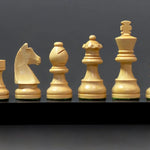
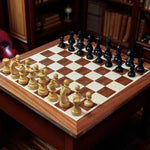
The Staunton pattern became the dominant chess set design because it combined elegance with clarity. Each piece is visually distinct, easy to recognise and suitable for serious play. This is why Staunton-style chess pieces remain the preferred design for clubs, tournaments, collectors and home players.
For most buyers, a Staunton chess set is the safest and most versatile choice. It works for beginners, experienced players and collectors alike, while offering a wide range of styles from simple club sets to luxury historical reproductions.
7. Quick buying recommendations
Best first wooden set
Choose a 3.25 inch or 3.5 inch Staunton set with a matching wooden board.
Best tournament-style set
Choose clear Staunton pieces with comfortable board spacing and stable weighting.
Best luxury choice
Choose ebony, rosewood or a finely finished reproduction set with premium board pairing.
Best gift option
Choose a complete set with pieces, board and storage for a practical ready-to-use presentation.
Frequently asked questions
What is the best chess set for beginners?
A beginner is usually best served by a clear Staunton-pattern set with medium-sized pieces and a matching board. The pieces should be easy to recognise and comfortable to move.
Are wooden chess sets better than plastic chess sets?
Wooden chess sets are generally preferred for home play, gifting and display because they feel more traditional and attractive. Plastic sets are often useful for schools, clubs and travel where durability and low cost are the priority.
What does weighted mean in chess pieces?
Weighted chess pieces contain added weight inside the base. This improves stability and gives the pieces a more solid, premium feel during play.
What is the most important thing when buying a chess set?
The most important factor is choosing a set that suits its purpose. Size, board match, design clarity, material and budget should all be considered together.
Is a Staunton chess set the best choice?
For most players, yes. The Staunton pattern is widely recognised, practical for play and available in many levels of quality, from simple club sets to luxury collector pieces.
Related Official Staunton guides
Continue exploring the key areas that help buyers choose, understand and care for quality chess equipment.
Did You Know?
A few important details help explain why traditional chess equipment has remained so fascinating to players, collectors and enthusiasts for generations.
The Staunton pattern began in 1849
The first Staunton chess pattern appeared in 1849 and remains the recognised standard for serious chess play more than 175 years later.
The knight is the most complex piece
Unlike most chessmen, the knight requires detailed shaping and careful finishing, making it one of the most demanding pieces to produce well.
No two wooden sets are identical
Natural hardwoods show individual grain, tone and character, meaning every genuine wooden chess set has its own unique appearance.
Weighting is about balance
Properly weighted pieces place mass low in the base, improving stability, handling and the overall feel of the set during play.
Frequently Asked Questions About Chess Equipment
These concise answers cover some of the most common questions asked by chess players, collectors and buyers when choosing quality chess equipment.
Why are chess pieces weighted?
Quality chess pieces are weighted to improve stability, balance and handling. Proper weighting lowers the centre of gravity, making pieces feel more secure and less likely to tip during play.
What size chess board do I need?
The correct board depends on the base diameter of the king rather than simply its height. Good proportions create comfortable spacing and a more attractive playing area.
What wood is best for chess pieces?
There is no single best wood. Ebony is prized for luxury and density, while boxwood, acacia, rosewood and walnut each offer different qualities in colour, grain and durability.
Are expensive chess sets worth the money?
Premium chess sets often reflect better materials, finer craftsmanship, improved finishing and greater historical accuracy. The best choice depends on whether the set is for play, display or collecting.
Why are Staunton chess sets the standard?
The Staunton pattern remains the standard because each piece is distinctive, practical and easy to recognise. It combines elegance with clarity, making it suitable for both casual and serious play.
How long should a wooden chess set last?
With sensible care and proper storage, a well-made wooden chess set can last for decades and may often be passed from one generation to the next.
Why do handcrafted chess pieces vary slightly?
Small variations are normal in handcrafted wooden pieces. Natural grain, finishing and detailed shaping all contribute to the individuality of a quality chess set.
Can I pair chess pieces with a different board?
Yes, provided the proportions are suitable. The king's base diameter should be matched with an appropriate square size to achieve balance, comfort and visual harmony.
Knowledge Centre tip: as this library expands, each of these questions can become a dedicated guide, with this page acting as the central reference hub for buyers, players and collectors.
Chess Myths & Facts
The world of chess equipment is full of assumptions that have been repeated for decades. Some are true, while others have become common misconceptions. Here are some of the questions and myths we encounter most often, together with straightforward factual explanations.
Weight alone does not determine quality. A well-designed chess piece should feel balanced and stable, with its weight positioned appropriately within the base. Good craftsmanship and proportion are just as important as overall weight.
Ebony is a natural hardwood, and every piece of timber displays unique grain patterns, colour variation and natural character. These differences are one of the qualities that make genuine wooden chess sets distinctive.
The size of a chess set should suit its intended use. Many players prefer medium-sized tournament pieces for regular play, while larger sets are often chosen for display or spacious playing environments.
King height is only one measurement. Base diameter also plays an important role when selecting a compatible chess board, which is why two different 4-inch chess sets may require different square sizes.
Small variations in wood grain, colour and fine detailing are a normal characteristic of quality handcrafted wooden products. These natural differences contribute to the individuality of each chess set.
Premium chess sets are enjoyed by collectors, enthusiasts and regular players alike. Higher-quality materials and craftsmanship can improve both the appearance of a chess set and the overall playing experience.
Expert Insight
When evaluating a chess set, it is helpful to consider the complete package rather than focusing on a single feature. Material, craftsmanship, balance, board compatibility, finish and intended purpose all contribute to the quality and enjoyment of a set. Understanding these factors allows buyers to make informed decisions based on practical considerations rather than common misconceptions.
Official Staunton Reference Tables
Use these quick-reference tables to understand common chess set sizes, board proportions, materials, weighting descriptions and equipment terms. They are designed as a simple starting point for comparing chess sets before reading the more detailed guides within the Knowledge Centre.
Common King Heights
| King Height | Typical Use |
|---|---|
| 3 inches | Compact home play, study sets and smaller boards. |
| 3.25 inches | Popular for casual home play and medium-sized wooden sets. |
| 3.5 inches | A versatile size for regular play, clubs and family use. |
| 3.75 inches | Commonly chosen for tournament-style and premium playing sets. |
| 4 inches | Often selected for luxury display sets and larger boards. |
Board Square Guidance
| Board Consideration | Why It Matters |
|---|---|
| King base diameter | The most important measurement when matching pieces to a board. |
| Square size | Determines whether the pieces feel crowded, balanced or too spaced out. |
| Total board size | Affects storage, table space and display presence. |
| Border width | Changes the visual appearance and overall footprint of the board. |
| Board material | Influences appearance, durability, weight and long-term care. |
Common Chess Woods
| Wood | General Character |
|---|---|
| Boxwood | Traditional light-side wood with a smooth, pale appearance. |
| Ebony | Dense, dark and highly prized for luxury chess pieces. |
| Ebonised boxwood | Boxwood treated to give a classic black appearance. |
| Acacia | Warm brown tones with attractive natural variation. |
| Rosewood | Rich colour and decorative grain, often used for premium sets. |
| Walnut | Popular for boards, boxes and elegant complete chess sets. |
Weighting Terms
| Term | Meaning |
|---|---|
| Unweighted | Pieces without added internal weight, usually lighter in feel. |
| Weighted | Pieces with added base weight for improved stability. |
| Double weighted | A common term indicating a more substantial feel than basic weighting. |
| Triple weighted | Usually used to describe heavier, more stable playing pieces. |
| Centre of gravity | The balance point of a piece; lower placement improves stability. |
Useful Equipment Terms
| Term | Explanation |
|---|---|
| King height | The standard measurement used to describe the size of a chess set. |
| Base diameter | The width of the bottom of a piece, important for board matching. |
| Staunton pattern | The recognised standard chess design used for most serious play. |
| Felted base | A soft underside that protects both the piece and the board surface. |
| Chessmen | A traditional term for the complete set of chess pieces. |
Buyer Priorities
| Priority | Look For |
|---|---|
| Regular play | Clear piece recognition, stable weighting and suitable board spacing. |
| Display | Attractive wood grain, polished finish and strong visual presence. |
| Gift | A complete set with pieces, board and storage where possible. |
| Collecting | Historical accuracy, craftsmanship, materials and presentation. |
| Tournament-style use | Practical proportions, recognisable Staunton design and durable handling. |
Reference note: these tables are intended as practical guidance rather than rigid rules. The best chess set is always the one that suits its purpose, space, budget and intended style of use.
8 Signs of a Well-Made Chess Set
When comparing chess sets, it is easy to focus on appearance alone. In reality, quality is determined by a combination of design, balance, craftsmanship and material selection. These are eight characteristics worth considering before making your choice.
Clear Piece Recognition
Each chessman should be immediately recognisable without hesitation. Distinctive silhouettes improve both casual and competitive play.
Comfortable Balance
A quality piece should feel stable in the hand and remain well balanced when placed on the board.
Consistent Craftsmanship
Look for uniform shaping, clean detailing and an overall sense of consistency across the complete set.
Natural Materials
Well-selected hardwoods provide attractive grain, character and long-term durability while giving every set its own individuality.
Appropriate Board Proportions
Pieces should have sufficient space to move comfortably without appearing crowded or isolated on the playing surface.
Smooth Finish
A carefully finished surface should feel pleasant to handle while allowing the natural beauty of the timber to remain visible.
Stable Felted Bases
Protective felt helps pieces glide smoothly across the board while reducing unnecessary wear during regular play.
Built for Long-Term Enjoyment
A thoughtfully made chess set is designed to provide years of enjoyable use and, with proper care, may remain in excellent condition for generations.
Official Staunton Knowledge Centre Insight
No single feature determines the quality of a chess set. The finest examples achieve a balance between thoughtful design, practical playability, material selection, careful craftsmanship and harmonious proportions. Considering these qualities together provides a more meaningful way to compare different chess sets than focusing on any one specification in isolation.
Understanding the Anatomy of a Staunton Chess Piece
Every Staunton chess piece is more than a decorative object. Its individual features have evolved over generations to create pieces that are attractive, comfortable to handle and instantly recognisable during play. Understanding the anatomy of a chess piece helps explain why the Staunton pattern has remained the world's preferred design.
Finial
The finial is the uppermost decorative feature of a chess piece. On the king it takes the form of a cross, while the queen traditionally carries a rounded crown or knop. These details help distinguish the major pieces at a glance.
Collar
Positioned beneath the head, the collar provides a visual transition between the upper section and the body. It contributes to the elegant proportions that characterise the Staunton pattern.
Stem
The stem forms the central body of many chess pieces. Its thickness and profile influence both the appearance of the piece and its overall balance when handled.
Shoulder
The shoulder gently widens towards the base, giving the piece visual stability while helping create the flowing lines associated with traditional Staunton design.
Base
The base provides stability during play and determines how comfortably the piece sits on the chessboard. Its diameter is one of the most important measurements when matching pieces to board squares.
Weighted Core
Many quality chess pieces contain an internal weight concealed within the base. Correct positioning improves balance while maintaining the natural proportions of the piece.
Protective Felt
A felted base allows pieces to glide smoothly across the board while helping protect both the playing surface and the underside of each chessman from unnecessary wear.
Overall Proportion
Perhaps the most important feature of all is proportion. The relationship between the head, body and base creates the balanced appearance that has defined the Staunton pattern for more than a century and a half.
Official Staunton Knowledge Centre Insight
A well-designed Staunton chess piece is the result of proportion rather than ornamentation alone. Every feature, from the finial to the felted base, contributes to recognition, handling, stability and visual harmony. It is this thoughtful combination of form and function that has allowed the Staunton pattern to remain the international benchmark for chess equipment.
```