


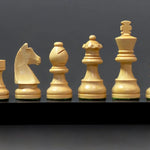
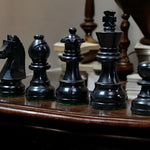
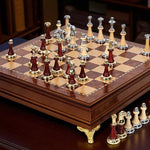
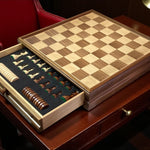



Have You Ever Wondered Why Chess Pieces Are Weighted?
Why Are Chess Pieces Weighted?
The practical reason, the history behind it, and why a well-balanced chess piece feels so different in the hand.
Pick up a well-made chess king and you notice the weight before almost anything else. It settles into the hand. It feels calm. Put it down and it stays exactly where you place it.
That simple sensation is one of the clearest differences between an ordinary chess set and a properly made one. Yet weighting is often described badly. Product listings talk about single weighted, double weighted or triple weighted pieces as though these were precise technical grades. In reality, those phrases are not governed by a universal standard.
What matters is not the label. It is whether the weight has been chosen and positioned properly for the shape of the piece.
A tall king needs stability. A broad rook should feel planted without becoming clumsy. A knight needs special attention because the carved head shifts the way the piece feels in the hand. A pawn should still have enough substance to feel part of the same set, but it should not feel like a miniature paperweight.
Weighting, when done well, is quiet engineering. It does not call attention to itself. It simply makes the chess set easier and more satisfying to use.
Better balance
A lower centre of gravity helps the piece remain upright and composed.
More control
The piece feels deliberate in the hand rather than light or hollow.
Greater stability
Accidental knocks are less likely to disturb the position.
Stronger finish
Weighting works together with proportion, felting and craftsmanship.
What Does “Weighted” Actually Mean?
A weighted chess piece has additional material secured inside its base. The purpose is to lower the centre of gravity and give the piece more stability.
The added material is normally hidden beneath the wood and covered by felt or baize. From the outside, a weighted and unweighted piece may look almost identical. The difference becomes obvious when the piece is handled.
Older chess sets used several types of weighting material. Lead was common historically because it was dense, easy to shape and inexpensive. Iron, brass and other metal inserts have also been used. Modern makers may use different alloys and safer production methods, but the underlying idea has not changed.
The weight is placed low in the body because that is where it has the greatest effect. Adding mass near the base creates stability. Adding the same amount too high in the piece would make it feel awkward and could even increase the chance of tipping.
The simplest definition
A weighted chess piece is not merely a heavier chess piece. It is a piece in which extra mass has been deliberately positioned to improve balance, handling and stability.
Why Were Chess Pieces Weighted in the First Place?
Early chessmen were not all weighted. Many historical sets were made as decorative objects, portable sets or straightforward playing pieces. Stability varied greatly from one design to another.
As chess became more organised during the eighteenth and nineteenth centuries, the demands placed on equipment changed. Public games, coffee-house play, clubs and tournaments required pieces that were easy to recognise and less likely to topple during a serious game.
Some pre-Staunton designs were elegant but tall and narrow. They could be surprisingly unstable. A sleeve brushing the board, a hurried move or a crowded position could disturb several pieces at once.
The Staunton pattern improved matters through broader bases and clearer proportions. Weighting took that practical improvement further. It made the pieces feel secure and helped the board remain orderly during play.
There was also a commercial reason. As buyers became accustomed to more substantial chessmen, weight itself became associated with quality. A well-weighted set felt more expensive because it required extra materials, extra production stages and more careful assembly.
That association remains today. Many customers cannot describe the engineering of a good chess piece, but they recognise the difference immediately when they lift one.
The history of weighting is not the story of a single invention on a single date. It was a gradual response to the practical needs of serious players and to rising expectations of what a quality chess set should feel like.
How a Weighted Chess Piece Is Made
The process begins after the piece has been turned or carved. A cavity is created in the underside of the base. The size and depth of that cavity depend on the design, the wood and the amount of weight required.
A metal insert is then fitted and secured. The exact method varies. Some makers use a shaped slug. Others use pellets or a cast insert. The weight must sit firmly. Any movement inside the base would be unacceptable because it could rattle, shift or damage the piece over time.
Once the insert has been secured, the underside is closed and prepared for felting. The felt protects the board, softens movement and gives the piece a finished appearance.
The visible part
- The turned or carved wooden body
- The polished surface
- The finished base profile
- The felt or baize underneath
The hidden part
- The cavity inside the base
- The metal weighting insert
- The material that secures the insert
- The closure beneath the felt
None of those stages should be rushed. Poorly fitted weighting can crack the base, loosen over time or create an unpleasant imbalance. Good weighting feels natural because it has been designed as part of the chess piece, not added as an afterthought.
Why Centre of Gravity Matters
Every physical object has a centre of gravity. In simple terms, it is the point around which the object’s weight is balanced.
A tall, narrow chess piece with most of its mass high above the board will tip more easily than a piece with a broad base and more weight lower down. This is why a good king does not rely on height alone. It needs a base wide enough to support it and enough low-positioned mass to keep it steady.
Weighting lowers the centre of gravity. That makes the piece more resistant to sideways force. It also changes how the piece feels when moved.
Players often describe a weighted piece as smooth or settled. What they are feeling is a more controlled relationship between the hand, the base and the board.
The effect is particularly noticeable with kings, queens and knights. The king is tall. The queen may have a delicate crown. The knight’s head projects away from the central axis. Each piece therefore presents a slightly different balancing problem.
This is one reason good sets do not use exactly the same weighting approach for every piece. The design should dictate the solution.
Are Heavier Chess Pieces Always Better?
No. This is one of the most persistent myths in the chess-set market.
A piece can be very heavy and still feel poor. If the base is too narrow, the extra weight may do little to improve practical stability. If the insert is oversized, the piece can feel dead and cumbersome. If the weight is badly secured, it may loosen or stress the wood.
The aim is not maximum weight. The aim is proportionate weight.
A good set should feel coherent. The king should have authority. The queen should feel elegant but substantial. The rook should feel solid. The bishop should feel balanced. The knight should not feel top-heavy. The pawns should remain comfortable to move repeatedly.
| Type of set | Typical weighting priority | What matters most | Common mistake |
|---|---|---|---|
| Travel set | Low or magnetic rather than heavy | Portability and secure placement | Making a compact set unnecessarily bulky |
| Club set | Moderate, practical weighting | Durability and quick handling | Chasing weight rather than robustness |
| Home wooden set | Balanced weighting across the army | Comfort, stability and visual presence | Ignoring square size and base width |
| Collector reproduction | Weight appropriate to the historic pattern | Authenticity, balance and craftsmanship | Overweighting a design that should feel refined |
What Do “Double Weighted” and “Triple Weighted” Mean?
Usually, they mean less than buyers assume.
There is no universal industry standard that defines a double-weighted or triple-weighted chess piece. One manufacturer’s double weighting may be heavier than another manufacturer’s triple weighting. The terms are generally used as marketing descriptions rather than precise engineering classifications.
That does not make them meaningless, but it does mean they should be treated cautiously.
A more useful product description gives the actual weight of the pieces, the king height, the base diameter and the intended board square. Those details tell the buyer far more than an unregulated label.
At Official Staunton, we prefer to focus on whether the pieces are appropriately weighted for their design. A historic reproduction should retain the character of the original pattern. A modern tournament set may need greater practical stability. A large display set may require additional weight simply because the pieces are taller.
The phrase sounds impressive. The result in the hand matters more.
Why Weighting Changes the Feel of a Game
Chess is an intellectual game, but physical handling still shapes the experience.
A lightweight piece can feel quick and functional. That may be entirely appropriate in a school, club or travel setting. A weighted wooden piece creates a different atmosphere. Moves feel more deliberate. The pieces remain aligned. The board feels calmer.
There is also a psychological element. People often associate weight with durability and quality. A substantial object feels dependable. That is true of watches, pens, tools and chess pieces.
However, the effect only works when the weight suits the design. A well-balanced piece feels reassuring. An over-weighted piece feels forced.
The best sets encourage the player to stop noticing the equipment. The pieces feel natural, so attention remains on the game.
Why Wood Density Still Matters
The metal insert is only one part of the total weight. The timber itself also contributes.
Ebony is naturally dense. Boxwood is fine-grained and substantial. Acacia, rosewood and other hardwoods each have their own weight and working characteristics. Two pieces of identical dimensions can feel different because the timber differs.
This is one reason natural wooden chessmen cannot be reduced to a simple number. Grain, moisture content and density vary. Skilled makers work within those natural differences while aiming for a coherent set.
The weighting should complement the wood rather than fight it. Dense ebony may require a different approach from a lighter stained boxwood piece. The goal is for both colours to feel appropriately matched during play.
Perfect numerical uniformity is less important than a balanced overall experience.
How Weighting Works with the Base and the Felt
A good chess piece is a system. Weight, base width, height, timber and felt all work together.
The base determines how much contact the piece has with the board. A broader base normally improves stability. The felt affects friction and movement. A very smooth felt allows the piece to glide, while a rough or poorly fitted felt can make even a well-weighted piece feel awkward.
The underside also needs to be flat. If the base rocks, extra weight will not fix the problem. It may simply make the rocking more noticeable.
That is why premium chessmen are inspected after weighting and felting. The piece should sit cleanly, move smoothly and remain stable.
These details are rarely visible in a product photograph, but they become obvious the moment the set is used.
How Official Staunton Approaches Weighting
Our approach is simple: the weight should suit the pattern.
We produce and retail a wide range of chessmen, from practical playing pieces to historically inspired reproductions. They should not all feel identical because they were not designed for the same purpose.
A tournament-style set needs dependable stability and immediate handling. A large antique reproduction may need enough weight to support its height while retaining the refinement of the original profile. A compact set should remain practical and easy to store.
We also pay attention to the relationship between the chess pieces and the board. A broad, heavily weighted king on a small square will still feel wrong. Good weighting cannot compensate for poor pairing.
This is why we consistently provide dimensions and recommend suitable square sizes. The set should be judged as a complete playing arrangement, not as thirty-two isolated objects.
For customers comparing options, we recommend looking beyond phrases such as double weighted. Check the king height. Check the base diameter. Look at the board square. Consider the intended use. Those facts are much more useful.
Who Benefits Most from Weighted Pieces?
Weighted pieces are especially useful for
- Regular home players
- Players who prefer substantial wooden sets
- Collectors who value tactile quality
- Faster games where accidental knocks are more likely
- Larger pieces with greater height
Lighter pieces may be better for
- Travel and portable sets
- Schools and large clubs replacing equipment often
- Very young children
- Players who need minimal carrying weight
- Decorative sets not intended for serious play
There is no moral virtue in choosing the heaviest set. The right choice depends on use.
Common Myths About Weighted Chess Pieces
Myth: Triple weighted always means best.
It does not. The phrase is not standardised. Balance matters more than the label.
Myth: All luxury pieces use the same type of metal.
They do not. Materials and methods vary between periods and manufacturers.
Myth: Weighting prevents every piece from tipping.
No piece is impossible to knock over. Weighting simply improves resistance and stability.
Myth: A heavier king automatically means a better set.
A heavy king with poor proportions or a narrow base can still feel awkward.
Myth: Unweighted pieces are always cheap.
Not necessarily. Some historical, decorative or travel sets are intentionally light.
Myth: Every piece in a set should weigh the same relative amount.
Different forms have different balancing needs. The king, knight and pawn should not be treated identically.
What Should You Look for When Buying?
Start with the purpose of the set.
For regular home use, look for weighted pieces with broad, stable bases and a king suited to the board square. For travel, magnetic stability may matter more than mass. For a collector reproduction, accuracy and historical character should sit alongside practical balance.
Read measurements carefully. A 4-inch king can vary greatly in base diameter and total weight. Look at photographs from more than one angle, especially the knight and the underside if shown.
Check whether the product description gives actual dimensions rather than relying entirely on terms such as luxury or triple weighted.
Finally, buy from a retailer that understands board pairing. Weighting is only one part of the experience. The pieces and board must work together.
A well-weighted set should feel confident, not exaggerated. When the engineering is right, the buyer notices the pleasure of the set rather than the effort behind it.
Frequently Asked Questions
Why are chess pieces weighted?
What is inside a weighted chess piece?
Are weighted chess pieces better?
What does double weighted mean?
What does triple weighted mean?
Can a chess piece be too heavy?
Does weighting damage chess boards?
Why do knights sometimes feel different from other pieces?
Are antique chess pieces weighted?
Should children use weighted pieces?
Are magnetic pieces the same as weighted pieces?
How can I tell whether a set is well balanced?
The Weight Should Serve the Design
Weighted chess pieces became popular because they improved real play. The best examples still follow that simple principle: enough mass to create confidence, placed low enough to improve stability, and balanced carefully so the piece remains comfortable in the hand.
That is the difference between a piece that is merely heavy and one that has been properly made.
Browse Chess Pieces Browse Complete Chess Sets
Leave a comment