






The Definitive Guide to the Chess Board: Selection, Setup, and Craftsmanship
A masterfully crafted chess board is far more than a simple grid of sixty-four squares; it's the foundational canvas upon which the artistry of the Staunton legacy is truly expressed. You've likely experienced that subtle irritation when a set of exquisite, triple-weighted pieces feels crowded on a surface that lacks the necessary breathing room, or perhaps you've hesitated to invest, fearing that a fine veneer might warp in the face of changing British seasons. It's a common dilemma for the discerning player who understands that the relationship between the king's base and the square size is a matter of both aesthetics and mathematical precision.
This guide will provide you with the technical clarity to select, set up, and preserve a professional-standard chess board that serves as both a strategic tool and a timeless centrepiece for your study. We'll explore the nuances of premium hardwoods like mahogany and walnut, explain the historical standards for board orientation, and reveal how to ensure your equipment remains a masterpiece for generations. By the time you've finished reading, you'll possess the confidence of a master craftsman in choosing a playing surface that perfectly complements your most cherished chessmen, ensuring your £500 investment stands the test of time.
Key Takeaways
- Learn to distinguish between a mere playing surface and a true collector’s piece by understanding the meticulous craftsmanship required for a professional-standard grid.
- Evaluate the vital differences between solid hardwoods and artisan veneers, ensuring your selection accounts for seasonal wood movement and enduring structural integrity.
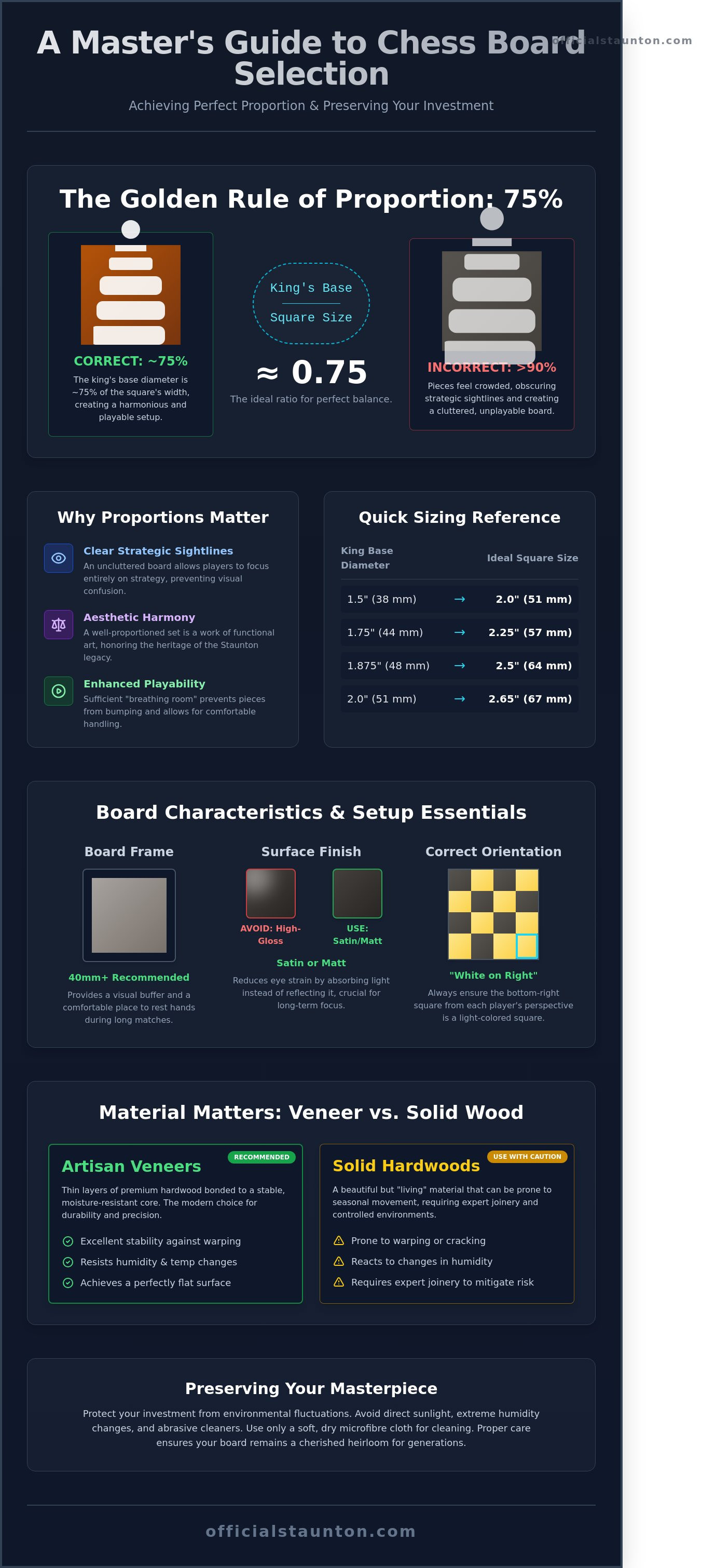
- Master the "75% Rule" to select a **chess board** that achieves perfect proportion, preventing a cluttered aesthetic while maintaining clear strategic sightlines during play.
- Ensure your matches begin with historical precision by mastering the "White on Right" orientation and the traditional sequence for arranging the Staunton pattern pieces.
- Discover the expert techniques required to preserve your board’s exquisite finish, protecting delicate grains and fine joinery from the subtle dangers of environmental fluctuations.
Understanding the Anatomy of a Professional Chess Board
A professional chess board is far more than a simple platform for play; it's a meticulously engineered field of battle. It consists of a 64-square grid, arranged in an 8x8 pattern of alternating light and dark squares that define the movement of every piece. While a casual observer might see only a surface, the connoisseur recognises the profound distinction between a utilitarian playing area and a collector's piece that serves as a masterpiece of functional art. To truly appreciate the Anatomy of a Professional Chess Board, one must look at how the 1849 Staunton standard transformed these grids into symbols of intellectual prestige.
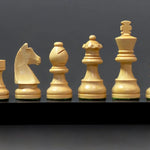
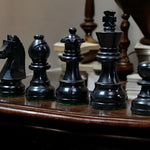
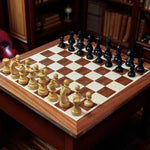
Selecting the right board is just as critical as choosing the chessmen themselves. A mismatch in scale or material can disrupt the visual harmony of a set, making the pieces feel crowded or lost. When you pair a set of heavy, triple-weighted Boxwood and Ebony pieces with a matching Macassar Ebony board, you aren't just setting up a game. You're creating a balanced aesthetic that honours the heritage of the Great Exhibition era, ensuring the chess board acts as a worthy stage for the drama of the opening and endgame.
To better understand the fundamentals of how these grids are organised and avoid common placement errors, watch this helpful video:
The Geometry of the Grid
The board is defined by its ranks and files, the horizontal and vertical lines that facilitate algebraic notation. Ranks are numbered 1 to 8, while files are lettered a to h. In professional circles, the width of the border, or the "frame," is a vital consideration. A generous frame of 40mm or more provides a necessary visual buffer, allowing the player's eyes to focus entirely on the 64 squares without distraction. It also offers a comfortable place for the hands to rest during matches that often exceed 150 minutes of intense concentration. Many of our artisan boards feature a slight 45-degree bevel on the edge, a subtle detail that adds a layer of Victorian sophistication to the heavy timber.
Visual Contrast and Eye Fatigue
The choice of finish is where craftsmanship meets practical psychology. Professional players almost always avoid high-gloss surfaces because the glare from overhead lighting can cause significant eye strain. Instead, we favour satin or matt finishes that absorb light rather than reflecting it. The contrast between the squares should be "quiet" yet clear. Traditional wood tones like Maple and Mahogany or Walnut provide a natural warmth that is far more pleasing than harsh, artificial colours. This organic palette helps maintain focus, ensuring the chess board remains a silent partner in the player's strategic journey. It's a small detail, but after three hours at the table, the difference between a loud contrast and a harmonious wood grain becomes very apparent.
The relationship between the grain of the wood and the carving of the pieces creates a tactile experience that digital interfaces simply cannot replicate. When you feel the weight of a 4-inch King on a solid wood surface, you're connecting with a tradition that spans nearly two centuries. This leads to an interesting point about how we actually select the materials for these surfaces to ensure they last for generations.
Selecting the Right Materials: Hardwoods, Veneers, and Artisan Quality
Choosing a chess board is an exercise in discerning the delicate relationship between nature and geometry. While the allure of solid wood is undeniable, it presents a unique challenge for the master craftsman. Solid timber remains a living material, prone to seasonal movement as it reacts to the shifting humidity levels found in a typical British home. Without the intervention of expert joinery, a solid board may warp or crack as the fibres expand and contract over the years.
This reality leads many connoisseurs to favour high-quality veneered boards. By applying thin, exquisite layers of premium hardwoods over a stable, moisture-resistant core, the artisan achieves a surface of professional precision that remains perfectly flat for generations. Every board bearing the Official Staunton seal undergoes a rigorous selection process, ensuring timbers are ethically sourced and seasoned for up to 24 months. This patient approach brings the wood to an optimal moisture content of approximately 10 per cent, preventing the heartbreak of a splitting grain in later years.
Another factor worth considering is the choice of species. The dark squares often feature the dense, oily richness of Ebony or the deep, chocolate tones of Black Walnut. These are traditionally paired with lighter woods like Sycamore or Maple to provide the clear, non-distracting contrast necessary for deep calculation. You might find that a handcrafted wooden board from our collection serves as both a functional tool and a lasting heirloom.
The Beauty of the Grain
Ebony remains the pinnacle of luxury in the chess world, offering a depth of colour and a natural weight that has commanded prestige since the Victorian era. For the serious club player, the combination of American Walnut and Maple provides the quintessential aesthetic for focused study. If you seek a more ornamental centrepiece, the swirling, chaotic patterns of Vavona or Walnut Burl offer a unique character, where every square tells a different geological story through its knots and burls.
Inlay vs. Printed Surfaces
A genuine artisan board is created through the meticulous process of inlaying, where individual wood squares are hand-fitted together to form a seamless battlefield. This is a stark contrast to mass-produced printed boards, which often use a heat-transferred image that eventually peels or fades at the edges. This leads to an interesting observation regarding the sensory side of the game. There's a particular, resonant "click" when a triple-weighted boxwood piece lands on a perfectly smooth, inlaid surface; it's a tactile feedback that cheaper, laminated alternatives simply cannot replicate.
Calculating the Perfect Proportion: Square Size and Compatibility
Achieving a precise balance between the battlefield and the combatants is a hallmark of the serious player. The "75% Rule" serves as a foundational principle for those who value both aesthetics and function; the diameter of your King's base should occupy approximately three-quarters of the square's width. When this ratio is ignored, the chess board often feels suffocated. Pieces that are too large for their squares create a cluttered environment that actively hinders strategic sightlines, making it difficult to calculate long-range Bishop diagonals or subtle Rook lifts across the ranks.
Official tournament standards generally gravitate towards a square size between 2 inches and 2.25 inches. This benchmark ensures that triple-weighted pieces have sufficient "breathing room" to be moved without upsetting their neighbours. Beyond the physical dimensions, visual cohesion is vital for a truly immersive experience. We recommend matching the timber of your pieces to the dark squares of the board. An Ebony set paired with an inlaid Macassar Ebony board creates a seamless, reverent aesthetic that honours the craftsmanship of the Victorian era. If you are just beginning your journey, learning how to set up a chess board with these proportions in mind will help you develop a better "feel" for the geometry of the game.
Sizing for Specific Series
Different designs carry different physical weights and silhouettes. For instance, The Morphy Series Chess Pieces, known for their slender elegance and historical accuracy, are perfectly at home on a 21-inch board with 55mm squares. In contrast, the Dubrovnik Series features much broader bases and a more robust profile. These pieces require a more expansive square to accommodate their unique stance, often necessitating a board with 60mm squares to avoid a cramped appearance. Use the following table as a guide for your next acquisition:
| Square Size (mm) | Recommended King Height (inches) |
|---|---|
| 50mm | 3.25" – 3.5" |
| 55mm | 3.75" |
| 60mm | 4.0" – 4.4" |
The Portability Factor
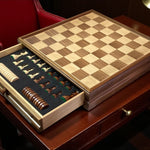
Choosing a board often involves a choice between a permanent display piece and a functional tool for travel. While a solid wood board is a magnificent addition to a study, a high-quality folding chess board allows for the luxury of real wood without the bulk. The key is the hinge mechanism. A poorly constructed hinge creates a "lip" or a gap that disrupts the flat plane of play, which can be incredibly distracting during a timed blitz game. A well-crafted 15-inch folding board is often the ideal middle ground for analysis, providing enough space for clear thought while remaining easy to store.
Another factor worth considering is the weight of the board itself. A heavy, solid wood board stays anchored during intense play, whereas lighter veneers might shift if a player is particularly animated. This leads to an interesting point about the tactile nature of the game; the way a piece "thuds" onto a thick, felted board is part of the sensory pleasure that a digital screen can never replicate. Finding that perfect marriage of piece and square is less about rigid mathematics and more about creating a space where your focus can remain entirely on the sixty-four squares.
How to Set Up Your Chess Board with Professional Precision
The transition from a mere wooden surface to a field of intellectual combat begins with the orientation of the chess board itself. A common oversight, even amongst those who have played for years, involves the rotation of the ranks and files. To maintain professional standards, you must ensure a light-coloured square sits in the bottom right-hand corner for both players. This "White on Right" rule isn't just a matter of tradition; it's the structural foundation upon which the entire geometry of the game is built. When the board is rotated incorrectly, the bishops find themselves on the wrong diagonals, and the strategic integrity of the opening is lost.
Once the board is correctly aligned, the assembly of the pieces follows a logical, inward progression. The rooks, those steadfast cornerstones of the back rank, occupy the four corners. Moving inward, the knights are placed adjacent to the rooks, followed by the bishops. The most critical step involves the placement of the monarch and his consort. A simple mnemonic remains the gold standard for accuracy: the Queen always stands on her own colour. A white Queen occupies a light square, while the black Queen sits upon a dark one. This leaves the final central square for the King, ensuring that the two sovereigns face one another across the divide.
The Ritual of the Opening
Setting the stage with meticulous care does more than just prepare the physical space; it prepares the mind. In professional circles, an incorrectly set board is seen as a sign of amateurism that can disrupt the mental flow of a grandmaster. This precision is vital for recording the game accurately using algebraic notation, where every square has a specific coordinate. If you misplace the King and Queen, the entire record of your tactical brilliance becomes a tangled mess of errors. Taking a moment to double-check the alignment before the first pawn move reflects a deep respect for the 1849 Staunton legacy and the discipline the game demands.
Coordinating Accessories
A professional environment is defined by the tools that surround the chess board. Positioning a DGT Chess Clock to the side of the board, usually on the right-hand side of the player with the black pieces, ensures that time management becomes a seamless part of the play. When the game concludes, the etiquette of the connoisseur dictates that pieces are not left scattered. Using a Fitted Chess Box protects the delicate carvings and prevents the fine woods from scuffing. For those who have dedicated a specific area of their home to the pursuit, placing the set upon a handcrafted Chess Table elevates the experience from a hobby to a permanent fixture of intellectual life.
The tactile sensation of placing a triple-weighted piece onto a perfectly polished square provides a grounding moment of clarity. It's a reminder that chess is as much a physical experience as it is a mental one. By adhering to these professional standards of setup, you honour the centuries of history that have shaped the game into the exquisite art form it is today. Discover the perfect centrepiece for your study by browsing our heritage collections.
Preserving the Legacy: The Art of Maintaining a Luxury Board
A luxury chess board is a living work of art. The woods used, such as rich mahogany or the deep, obsidian hues of ebony, remain sensitive to their atmosphere long after the artisan has completed their work. Placing a fine board in direct sunlight is a frequent error that leads to irreversible fading or, even worse, the warping of delicate veneers. Central heating in British homes during the winter months often creates a dry environment that draws moisture from the timber, which can cause the wood to contract and eventually crack. It's often wise to maintain a consistent humidity level in the room where your set resides to ensure the timber stays stable.
Routine Care and Cleaning
Maintaining the pristine surface of a board requires a disciplined approach. A soft, dry microfibre cloth is the most effective tool for removing dust from intricate inlays without risking scratches. One should never use a damp cloth on a fine veneer; moisture can seep into the grain and cause the layers to lift or bubble over time. There are a few key rules to remember:
- Avoid Silicone: Furniture polishes containing silicone should be strictly avoided as they create a greasy film that masks the natural grain and traps dirt.
- Address Scratches: Minor surface abrasions can often be disguised using specialist wood markers or high-quality oils that match the specific tone of the wood.
- Natural Lustre: Using a small amount of natural beeswax or carnauba wax every six months helps maintain the wood's radiance without causing a heavy build-up.
Long-term Storage
When a board isn't in use, the method of storage is just as vital as the environment it sits in. You should always store a high-quality chess board flat rather than on its side. Propping a board up against a wall for long periods invites gravity to slowly bow the wood, a tragedy that is difficult to reverse. For those who value their collection, using a felt-lined storage bag offers an essential layer of protection against accidental knocks and dust.
If a board has already suffered significant damage or shows signs of age, seeking professional Chess Set Restoration Services is the only way to ensure the piece is handled with the reverence it deserves. Experts who understand the nuances of 19th-century craftsmanship can often breathe new life into a tired surface. A well-tended board is an investment that matures in character, developing a unique patina over several decades that tells the story of every match played on its surface. It's this commitment to care that transforms a simple gaming surface into a cherished family heirloom.
Investing in a Legacy of Play
Selecting a fine chess board isn't merely a practical choice; it's an act of stewardship for a tradition that spans centuries. Whether you're carefully measuring square sizes to match your pieces or selecting the deep, resonant hues of sustainable rosewood, the focus remains on the tactile harmony between player and board. A well-chosen surface transforms every opening into a more profound experience, grounding the intellectual rigour of the match in the physical beauty of artisan woodworking.
At Official Staunton, we've remained dedicated to these exacting standards since 1993, even serving as proud suppliers to the British Museum. We believe that a professional-grade board should endure as long as the game itself, which is why we provide a 3-year warranty on all our premium wooden selections. This commitment ensures that your investment remains protected as it develops its own unique character over decades of use.
We invite you to explore our curated collection of luxury wooden chess boards and find the piece that speaks to your own sense of history. There's a quiet, particular joy in finding a board that feels just right under your hand; it's a feeling we hope you'll experience very soon.
Frequently Asked Questions
What is the standard size for a competition chess board?
The standard dimensions for a tournament-grade surface, as mandated by the World Chess Federation (FIDE) handbook section 02, require square sizes to measure between 50mm and 65mm. Most professional competitions in the United Kingdom favour a 55mm square, which provides the necessary expanse to accommodate a king with a base diameter of approximately 45mm. This specific ratio ensures the field of play remains uncluttered, allowing the strategic geometry of the Staunton pattern to be observed without visual obstruction.
How can I tell if a chess board is made of real wood or plastic?
Discerning the difference between an artisan wooden surface and a synthetic imitation requires a keen eye for the organic irregularities of the grain. You'll notice that real wood exhibits a unique, non-repeating cellular structure across its surface; if you observe three identical squares, it's almost certainly a printed laminate. A genuine timber board possesses a distinct weight and a natural warmth to the touch that cold, hollow plastic simply cannot replicate, especially when priced above the £100 threshold where craftsmanship becomes evident.
Why is the bottom right square always white?
The requirement for the h1 square to be light-coloured is a fundamental tenet of chess orthography that has been codified since at least the 15th century. This orientation ensures that the queen is placed on her own colour, a rule that preserves the symmetry of the initial array across both sides of the board. Without this specific alignment, the tactical landscape of the opening would be fundamentally altered, departing from the traditional aesthetic established by the Victorian masters of the game.
Can I use a 20-inch board with 3.75-inch chess pieces?
Pairing a 20-inch chess board with 3.75-inch pieces is a common choice, though it's the square size rather than the board's outer edge that dictates the harmony of the set. A 20-inch board typically features 50mm (approx. 2-inch) squares, which perfectly accommodate a 3.75-inch King with a 1.6-inch base. This configuration leaves roughly 20% of the square's area vacant, providing the requisite breathing room that serious players require to navigate complex positions without feeling cramped.
What is the best wood for a chess board to prevent eye strain?
To mitigate visual fatigue during a four-hour match, master craftsmen often recommend a combination of Walnut or Mahogany paired with Maple. These timbers offer a soft, natural contrast that is far gentler on the eyes than the jarring black-and-white patterns found on cheaper sets. Selecting a board with a satin or matte finish is equally vital, as it eliminates the 90% glare from overhead lighting that frequently plagues high-gloss surfaces and distracts the focused mind.
How do I clean a wooden chess board without damaging the finish?
Preserving the exquisite finish of a high-quality chess board requires a delicate touch and a total avoidance of harsh household chemicals. A soft, lint-free microfibre cloth should be used to remove dust, followed by a very slightly damp cloth if a spill occurs. For deeper maintenance, applying a small amount of high-grade Renaissance Wax every 12 months will nourish the timber and maintain the protective barrier without leaving the greasy residue associated with inferior furniture polishes.
Is a solid wood board better than a veneered one?
While a solid timber board carries a certain weight of prestige, a high-quality veneered board is often superior in terms of structural longevity. Modern marquetry techniques allow artisans to layer thin slices of exotic woods over a stable MDF or plywood core, which prevents the expansion and contraction that often leads to cracking. In the variable climate of the United Kingdom, where humidity can fluctuate by 30% between seasons, a well-constructed veneered surface offers a level of precision and stability that solid wood rarely matches.
What should I do if my wooden chess board starts to warp?
If you notice your wooden board beginning to cup or warp, it's usually a sign that the ambient humidity has dropped below the ideal 40% to 50% range. You shouldn't attempt to force the wood back into place with weights, as this often results in permanent structural fractures. Instead, slowly reintroduce moisture to the environment using a dedicated humidifier and ensure the board is stored flat, away from direct heat sources like radiators, to allow the fibres to stabilise naturally over several weeks.
Selecting a board is ultimately about finding a balance between historical reverence and practical durability. Whether you choose the steadfast stability of a fine veneer or the heavy presence of solid timber, the board serves as the silent foundation for every calculated move and hard-won victory. It is more than a surface; it's a piece of heritage that, when cared for with the respect it deserves, will witness the evolution of your game for decades to come.
Leave a comment