





Why Do Some Chess Knights Look So Different?
Why Do Some Chess Knights Look So Different?
The knight is the one piece in a Staunton set that gives the maker extraordinary room for character. That freedom is exactly why collectors pay it so much attention.
Put ten different Staunton chess sets side by side and the kings, queens, bishops and rooks will usually reveal an obvious family resemblance. Then look at the knights.
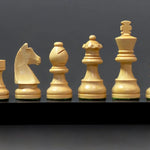
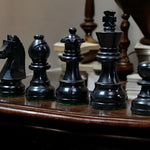
One may have a long, elegant muzzle and a restrained mane. Another may have a broad forehead, deep jaw and powerful neck. A third may have flared nostrils, sharply defined ears, teeth and an expression that gives it almost as much personality as a small sculpture.
Yet all three can quite properly belong to Staunton chess sets.
Why does one chess piece have so much freedom?
The answer lies partly in the way chessmen are made and partly in the history of the Staunton pattern itself. The knight is unlike every other piece on the board. Most of the main forms of a wooden Staunton set are created on a lathe, where the piece rotates around a central axis. The knight begins with a turned base and body, but its horse's head requires shaping in more than one plane. Its silhouette, muzzle, jaw, ears, mane, eyes and neck all have to be formed.
That makes the knight the natural place for a chess set to acquire an identity of its own.
Profile
The angle and silhouette of the head can change the character of the entire set.
Mane
It may be plain, deeply cut, swept back or highly detailed depending on the pattern.
Expression
Eyes, nostrils, jaw and mouth can make a knight restrained, alert or dramatic.
Balance
A beautiful head still has to sit convincingly above a stable playing base.
The Knight Has Always Been the Odd One Out
Look at the construction of the other pieces.
A pawn is essentially a sequence of circular forms. So are the main bodies of the king, queen and bishop. A rook is more complicated at its crown, but its basic body is still rotational. Put the blank on a lathe and the maker can establish the principal profile around a central axis.
A horse's head does not work like that.
It has a front and a back, two sides, a muzzle projecting away from the neck and features that need to be read from several angles. Even a very simple knight needs a recognisable head and neck. A more elaborate historic knight can require considerably more definition.
This difference explains why the knight became such an obvious signature piece. A maker could retain the familiar Staunton family while giving the knight a different posture, facial treatment or mane.
A useful way to judge a set
If you want to understand the level of thought that has gone into a set of wooden chessmen, spend a little time looking at the knights. They often tell you more than the king does.
What Did the Original Staunton Knight Establish?
The Staunton pattern was registered in 1849 and subsequently manufactured by Jaques of London. Its success came from giving the pieces clear, recognisable forms while retaining broad bases and practical proportions for play.
The knight was represented by a horse's head, a choice commonly associated with classical equestrian sculpture. The important point is that the 1849 pattern established a language rather than a rule saying that every future knight had to be an exact copy.
A Staunton knight needed to be unmistakably a knight. It needed to sit within the proportions of the rest of the army. Its base needed to relate to the bishop and rook. But there remained enormous scope in the treatment of the horse itself.
That is why the Staunton pattern could become standardised without becoming visually monotonous.
Over time, manufacturers altered proportions and details. Different production periods developed their own character. Some knights were finely modelled and expressive; others were simplified for durability, cost or faster manufacture.
The result is something collectors now know very well: two sets can both be unmistakably Staunton and yet have knights that appear to come from completely different stables.
The Features That Change a Knight's Character
You do not need specialist knowledge to see the differences once you know where to look.
| Feature | What can vary | What it changes |
|---|---|---|
| Head angle | Upright, forward or swept back | The knight can appear calm, alert or aggressive. |
| Muzzle | Short, long, narrow or broad | Changes the overall silhouette immediately. |
| Jaw | Shallow, deep or strongly defined | Gives the head delicacy or visual power. |
| Ears | Small, long, upright or laid back | A surprisingly important part of the period character. |
| Mane | Plain, incised, layered or deeply formed | Often determines how elaborate the knight feels. |
| Eyes and nostrils | Suggested or strongly defined | Adds expression without changing the basic profile. |
| Mouth | Closed, open or detailed with teeth | Can turn a restrained design into a dramatic one. |
| Neck | Fine, broad, straight or curved | Affects both appearance and physical strength. |
None of these details can be judged entirely on its own. A long muzzle may look elegant on one neck and badly proportioned on another. Deep mane work may suit a large collector set but overwhelm a compact tournament knight.
The successful design is the one in which the details belong together.
Why More Detail Does Not Automatically Mean a Better Knight
This is worth saying because elaborate carving is easy to sell.
A knight with individual teeth, deep nostrils and a highly cut mane can demonstrate considerable work. But detail alone does not make a good chess piece.
The profile has to be right. The head needs to relate to the neck. The neck needs to relate to the base. The knight must sit comfortably beside the bishop and rook. It also needs to survive being handled.
A restrained tournament knight may be an excellent piece of design precisely because unnecessary projections have been removed. It is easy to recognise, quick to pick up and less vulnerable to damage.
At the other end of the scale, an elaborate reproduction may need considerable detail because those details are part of the historic pattern being recreated.
So the question is not, “How much carving does this knight have?”
A better question is, “Does this carving belong to this design?”
The best knight is not necessarily the most complicated horse's head. It is the one whose character, proportions and finish make sense within the complete set.
Why Russian, Zagreb and Dubrovnik-Style Knights Feel So Different
Move away from nineteenth-century English Staunton patterns and the range becomes even wider.
Twentieth-century European and Soviet-era playing sets often developed bolder, cleaner forms. Some used simplified knights with broad surfaces and very little facial detail. Others created immediately recognisable silhouettes through the angle of the head or the shape of the mane.
Zagreb-style knights are often recognised by their distinctive profile and flowing treatment of the head. Dubrovnik-inspired sets tend to appeal for a different reason: clarity, solidity and an understated form that feels designed for serious play rather than ornament.
Russian and Soviet tournament patterns produced still more interpretations, some highly economical and others full of character.
These designs demonstrate an important point. A knight does not need Victorian detailing to be memorable.
A few well-judged lines can be enough.
Why Historic Knights Are Difficult to Reproduce Properly
Suppose you have an original antique knight in front of you. Making a modern horse's head that looks vaguely similar is not particularly difficult. Reproducing the character of that specific knight is another matter.
Small errors accumulate quickly.
If the muzzle is slightly too short, the face changes. If the forehead is too rounded, the silhouette changes. If the ears sit at the wrong angle, the period character can disappear. A neck that is only a little too thick can make an elegant antique pattern look heavy.
This is why historic reproduction cannot be reduced to adding decorative carving to a generic knight blank.
The master pattern matters.
At Official Staunton, our reproduction work uses pantograph-guided formation for complex knight forms, followed by skilled hand finishing. The pantograph allows the essential geometry of a master pattern to be transferred consistently to the wooden blank. The piece is then finished by hand rather than emerging as a completely finished object from an automated CNC process.
This distinction matters to us. Precision is useful where it preserves a historic profile. Human finishing remains necessary where wood, detail and surface treatment require judgement.
What a Pantograph Actually Does
The word sounds more complicated than the principle.
A pantograph is a mechanical copying system. A guide follows a master form while the linked cutting system transfers that shape to another piece of material.
For a chess knight, this helps establish the important masses and contours repeatedly. It is particularly useful when the aim is to preserve the character of a historic master rather than ask different carvers to reinterpret the horse from scratch each time.
It does not remove the nature of wood. Grain varies. Density varies. Small finishing decisions remain. Sanding, refinement and final inspection still influence the finished piece.
Nor does it make every knight microscopically identical. That is neither realistic nor necessarily desirable in a handcrafted wooden set.
What it does is give the workshop a much stronger starting point for consistency.
Should All Four Knights Be Exactly Identical?
They should clearly belong together.
The profile, proportions, size and overall detailing should match closely enough that one knight does not look as though it wandered in from another chess set.
But wooden pieces are not injection-moulded plastic components.
The grain can affect a fine edge. Hand finishing can leave tiny differences. One eye may sit fractionally differently when examined at very close range. A line in the mane may follow the wood slightly differently.
These are normal characteristics when they are subtle.
There is an important distinction between variation and poor matching. A visibly different head size, badly misaligned feature, uneven base or crude mismatch is not something that should be excused simply by calling the set handmade.
Good craftsmanship produces consistency without pretending the material is synthetic.
The Knight Also Has to Work as a Chess Piece
It is easy to become absorbed by the sculpture and forget that the knight is equipment.
A projecting horse's head moves the visual and physical mass away from the central axis. The base therefore matters enormously. A tall, heavy head on a narrow base can make a knight feel unstable even if it looks impressive in a photograph.
Weighting can help, but weighting cannot rescue fundamentally poor proportions.
The neck also has to withstand normal handling. Extremely thin sections and delicate ears may look impressive but can be vulnerable if the set is intended for frequent play.
This is one reason historic tournament patterns often feel different from display-oriented luxury sets. Practicality exerts pressure on design.
The best playing knight gives you character without making you nervous every time you pick it up.
Why Collectors Look at the Knight First
Collectors learn to recognise patterns through small details.
A king can establish scale and a rook can reveal the quality of the turning, but the knight often gives away the identity of a set almost immediately.
Its silhouette can indicate a particular period, workshop tradition or reproduction style. On antique sets, changes in knight form can sometimes help distinguish production characteristics, although attribution should never be made from one feature alone.
There is also a simpler reason.
The knight is interesting.
It is the place where technical woodworking meets sculpture. It has a face. People respond to faces. A particularly successful knight can give an otherwise restrained set enormous personality.
This is why customers sometimes fall for a set because of its knights before they have even checked the king height.
How to Judge a Knight When Buying a Chess Set
Start with the side profile. Does the head look balanced or does it seem too large for the base?
Then look from the front. The head should sit convincingly over the neck and the principal features should be sensibly aligned.
Compare the four knights if photographs allow it. They should share the same character.
Look at the transition between the carved head and turned base. On a good design it should feel intentional rather than as though a horse's head has simply been placed on top of an unrelated pedestal.
Think about use. Fine ears, deep undercuts and elaborate teeth may be exactly what you want in a collector set. For a set that will be used every evening, a more robust design may make better sense.
Good signs
- A confident, recognisable silhouette
- Four knights that clearly belong together
- Clean transition from head to neck and base
- Detail appropriate to the size of the piece
- A broad enough base for stable play
Look more closely when
- The head appears oversized for the base
- Matching knights have obviously different profiles
- Fine projections look unnecessarily fragile
- Carving seems rough rather than deliberately textured
- The set relies on detail to disguise poor proportions
Why the Knight Can Define the Whole Chess Set
There is a useful design lesson here.
The strongest chess sets are not collections of six individually impressive pieces. They are families.
The king establishes authority. The queen should sit naturally beside it. Bishops and rooks need enough presence to remain distinct. Pawns create the rhythm across the front rank.
The knight is allowed to interrupt that rhythm just enough to give the army character.
If it is too plain for an ornate set, something feels missing. If it is extravagantly carved beside severe tournament pieces, it can feel as though it belongs elsewhere.
That relationship is why reproducing historic chessmen is more demanding than reproducing individual objects. We are not trying to make one attractive horse. We are trying to recreate the knight that belongs to a particular chess set.
There Is No Single Perfect Staunton Knight
After more than a century and a half of Staunton chessmen, it would be strange if there were.
Some players prefer the early English look. Others love the muscular detail of later luxury knights. Some are drawn to Soviet simplicity. Others immediately recognise the sweeping profile of a Zagreb-style set or the understated strength associated with Dubrovnik designs.
That variety is not a weakness in the Staunton pattern. It is one of the reasons the pattern has endured.
The essential identities of the pieces remain clear while designers and makers retain enough freedom to interpret proportion and character.
Nowhere is that freedom more visible than in the knight.
If the king tells you how large a chess set is, the knight often tells you what kind of chess set it wants to be.
Frequently Asked Questions
Why do chess knights look different between sets?
Are all Staunton knights supposed to look the same?
Why is the knight harder to make than other chess pieces?
Is a more detailed knight better?
Why do collectors care so much about chess knights?
Should handmade wooden knights be identical?
What is a pantograph-made chess knight?
Is pantograph production the same as CNC?
What should I look for in a good chess knight?
Why do some chess knights have teeth?
Why are some tournament knights very simple?
Which chess knight design is best?
The Piece That Gives a Chess Set Its Face
The knight is where history, woodworking and design become most visible. Its job is simple — to represent one chess piece clearly — but the number of ways makers have achieved that is remarkable.
For us, that is precisely what makes historic chessmen worth reproducing carefully. Get the knight right and much of the personality of the original set returns with it.
Browse Chess PiecesHistoric Reproduction Sets
Leave a comment