


A City Renamed
Petrograd became Leningrad, the name under which the city would be known through most of the Soviet era.


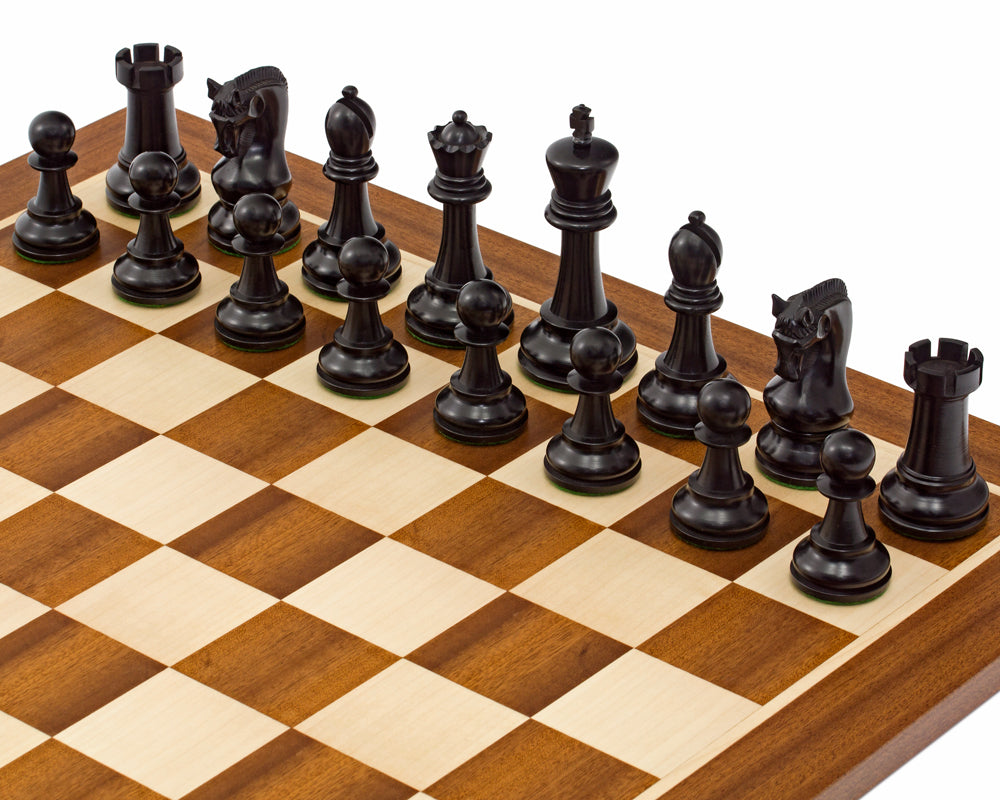
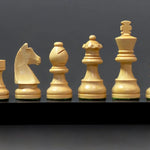
A bold Eastern European interpretation of the Staunton tradition—defined by long architectural stems, broad tournament bases and one of the most recognisable knight profiles in modern wooden chess.

The Staunton system supplied chess with a universal visual vocabulary, but it never prevented regional makers from developing their own accents. Across the Soviet Union and Eastern Europe, familiar piece symbols were repeatedly adapted into forms suited to clubs, schools, tournaments and domestic play.
The design sold today as the Leningrad pattern belongs to that broader tradition. It retains immediate Staunton legibility while replacing restrained Victorian proportions with taller stems, assertive collars, deeply profiled bases and a dramatically carved knight.
The result feels recognisably classical yet unmistakably different. It is not a reproduction of a Jaques pattern, nor does it need to be. Its appeal lies in the directness, rhythm and visual confidence commonly associated with twentieth-century Eastern European chess equipment.
Leningrad—today Saint Petersburg—was one of the great centres of Soviet chess. The city hosted major competitions, produced outstanding players and sustained an unusually deep chess culture through clubs, schools and organised events. Within the Soviet system, chess equipment was produced in many factories and workshops, often in evolving regional forms rather than under one permanent commercial specification.
Petrograd became Leningrad, the name under which the city would be known through most of the Soviet era.
Major Soviet tournaments helped establish chess as organised culture, education and public spectacle.
Even during the blockade, chess activity endured; surviving museum material records sets made in the besieged city.
Leningrad became associated with strong players, rigorous training and a flourishing network of chess institutions.
“Leningrad” is widely used for several related modern and reproduction designs inspired by Soviet aesthetics.

A large spherical head, narrow neck and layered base create excellent visual rhythm across the rank.
A tall architectural stem rises to a broad crown, producing authority without excessive ornament.
The flared coronet echoes the king’s mass while retaining a distinctly lighter and more open profile.
A rounded mitre and clean diagonal slot give instant recognition from every practical playing angle.
A cylindrical tower, pronounced battlements and stable base communicate strength with economy.
The carved mane and long descending neck transform the only non-turned piece into the visual signature.
Most Staunton families are remembered by their knights, and the Leningrad-style pattern is no exception. Its horse is upright yet fluid: the mane follows the entire outer curve, the neck creates a deep open arch, and the head turns inward with a concentrated, almost severe expression.
The carving is decorative without losing board clarity. Strong ears, defined brow, incised mane and carefully shaped muzzle remain visible at normal playing distance, while the broad lower body integrates naturally with the turned base shared by the army.
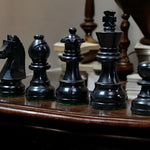
In black or ebonised wood the design appears monumental and graphic. In acacia it becomes warmer and more visibly tactile, revealing grain through the carved planes. Both interpretations preserve the pattern’s essential strength.

Soviet chessmen were not governed by one universal aesthetic. Nevertheless, many surviving twentieth-century sets share practical tendencies: economy of turned form, pronounced bases, strong piece differentiation and minimal applied decoration. The Leningrad-style design translates those tendencies into a refined contemporary set.
Each piece has a distinct crown, head or upper body, allowing rapid identification during serious play.
Long stems and repeated collars create a coherent skyline without making the army visually uniform.
Broad lower profiles and weighted construction provide the reassuring planted feel expected of full-size pieces.
Decoration is concentrated where it matters—in crowns, battlements and the knight—rather than spread across every surface.

Official Staunton’s Leningrad chessmen are contemporary wooden sets inspired by the visual language of Eastern European chess. The major bodies are turned to establish consistent height, collars and base geometry; the knights are shaped separately and refined to preserve the carved features that define the pattern.
Core weighting gives the pieces a secure centre of gravity, while green felt protects the board and softens movement. Each army is finished to bring out either the deep, formal character of black chessmen or the natural grain and warmth of acacia and boxwood.
The objective is not artificial antiquity. It is to produce a usable, full-size chess set with historical atmosphere, clear visual identity and the durability required for regular ownership.
Dense, workable timbers are chosen for clean turning, controlled finishing and a satisfying tactile quality.
Repeated collars, stems and bases are shaped for visual consistency across the complete 34-piece set.
The horse forms receive individual cutting and hand refinement to define the mane, face, ears and neck aperture.
Core weighting improves stability; fitted green felt allows smooth movement and protects polished boards.


The same profile can take on a markedly different personality according to timber and presentation. Choose chessmen alone for an existing board, or select a complete combination designed around the scale of the 4-inch king.
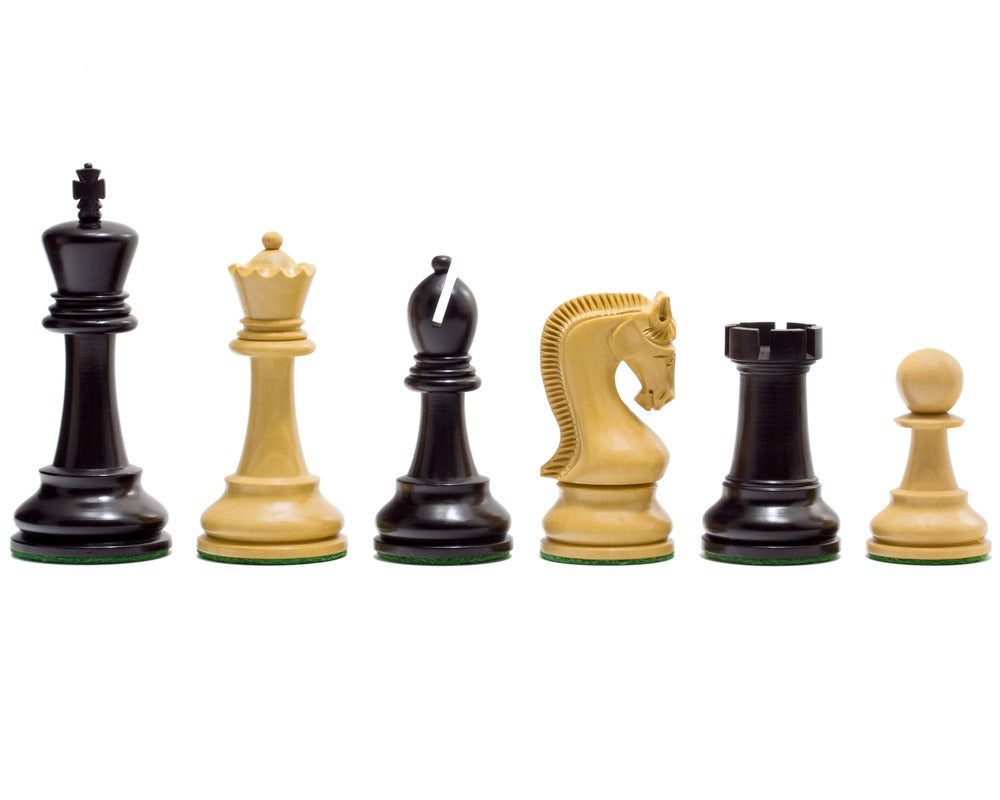
A formal monochrome interpretation with a commanding board presence, full 34-piece complement and extra queens.
View the chessmen →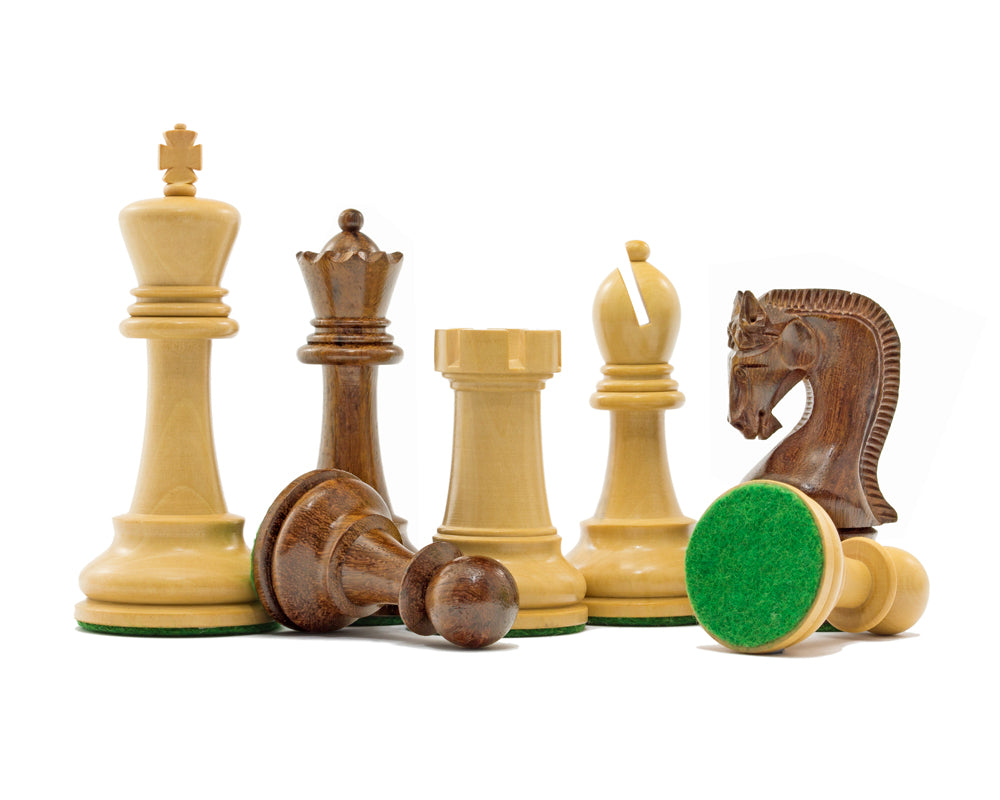
Warm acacia grain gives the pattern a softer, more traditional appearance while preserving its strong Eastern European silhouette.
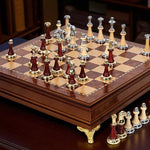
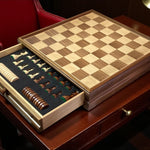
View the chessmen →A coordinated playing set pairing the dramatic black army with a warm mahogany and maple board and practical storage.
View the complete set →
In black and natural boxwood, the Leningrad pattern becomes especially graphic. The dark army emphasises the height of the stems, the repeated rings at the collars and bases, and the deeply cut knight silhouette.
Paired with a 19-inch mahogany and maple board, the 4-inch king has the visual room required to feel substantial without crowding the squares. The board’s warmer brown tone prevents the black pieces from appearing stark, while the natural army retains excellent contrast.
The principal considerations are finish, board scale and intended use. Because the Leningrad king is tall and the bases are substantial, sufficient square size is important for both appearance and practical movement.
Answers about the pattern, its historical context, construction and practical ownership.
Choose a bold black interpretation, the natural warmth of acacia, or a complete board-and-box combination built around one of the most distinctive Eastern European-inspired Staunton patterns.