





Chess Boards: How to Choose the Right One
A chessboard is not simply the surface beneath the pieces. Its square size determines whether a game feels comfortable to play; its timber and finish influence how it settles into a room; and its proportions can either flatter a handsome set or make even fine chessmen look misplaced. The best chess boards bring these details together so naturally that the player notices only the game.
For a first quality set, a club board or an heirloom display piece, the right choice begins with how it will be used. A practical board for regular games has different priorities from a large inlaid board intended for a study or drawing room. Understanding those differences makes it far easier to buy with confidence and enjoy the result for many years.
Choosing chess boards by use
The most useful question is not, “Which board is best?” It is, “Where and how will this board be played?” A board used several evenings a week should be stable, easy to clean and sized for relaxed handling. A board chosen primarily as a gift or furnishing piece may justify richer hardwoods, more elaborate inlay and a larger presentation.
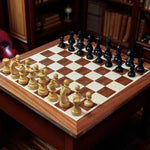
For home play, a traditional wooden board with sensible square dimensions is often the most rewarding choice. Wood has warmth, visual depth and a pleasing relationship with Staunton pieces that moulded or printed surfaces rarely match. A quality veneer board can offer excellent value, while solid-wood construction and finely executed inlay provide a more substantial, long-term proposition.
Club and tournament players usually need clarity before decoration. The squares must offer clear contrast without glare, the board must sit flat, and the dimensions should comply with the pieces being used. Tournament-style boards are designed to support concentration rather than compete for attention. A correctly proportioned board also makes notation, analysis and rapid play more comfortable.
Travel and holiday use call for a different compromise. Magnetic chess boards keep pieces secure in transit and suit trains, hotel rooms and smaller tables, although they do not offer the same presence as a full-size wooden board. Folding boards are convenient, but the central hinge and reduced square size are worth considering if the set will also be used for serious games at home.
Square size is the detail that matters most
The relationship between a board and its pieces is the foundation of an attractive chess set. Buyers are often drawn first to the king height, the carving or the wood of the pieces. Yet square size is usually the deciding factor in whether the complete arrangement looks balanced and plays properly.
As a general guide, the king’s base should occupy around 75 to 80 per cent of the width of one square. This leaves enough room to move each piece cleanly without making the board look sparse. A piece with a 38 mm base, for example, is commonly suited to a square of roughly 50 mm. The exact match can vary with the style of the chessmen: broad, heavily weighted pieces need more room than slender, finely turned patterns of the same height.
A board that is too small creates crowding. Pawns become difficult to grasp, knights collide with neighbouring pieces, and the position loses its visual order. A board that is too large is less troublesome in play, but can make a modest set seem undersized and detached. This is why matched set-and-board combinations are so valuable, particularly when buying online.
If you already own pieces, measure the diameter of the king’s base rather than relying on the stated king height alone. If you are choosing a complete set, check that the supplier has specified a recommended square size. It is a small piece of information with an outsized effect on the finished set.
A note on overall board dimensions
A standard 50 mm square produces a playing field of 400 mm before the border is added. With a generous frame, the finished board may be close to 480 mm or more across. That is a handsome size for a dining table, desk or occasional table, but it needs a permanent or readily available surface.
Before selecting a larger board, consider where it will live between games. A fine board deserves storage that protects it from knocks, changing temperatures and prolonged direct sunlight. If space is limited, a slightly smaller board that is brought out and used regularly is generally a better purchase than a grand board left in its box.
Timber, colour and character
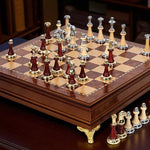
Traditional chess boards rely on contrast. Dark and light squares must be easy to distinguish at a glance, yet their pairing should feel harmonious rather than harsh. Walnut with maple, mahogany with maple, and rosewood-toned timbers with boxwood are enduring combinations because they provide that clarity while retaining the character of natural wood.
Each timber brings a different mood. Walnut is quietly elegant, with a warm brown grain that suits both contemporary and traditional interiors. Maple offers a pale, clean counterpoint and reflects light gently. Darker exotic hardwoods create a more formal appearance, often favoured for collector sets and rooms with richer furnishings. No two boards made from natural materials will look precisely alike, and that individual variation is part of their appeal.
The finish matters as much as the timber. A high-gloss surface can look impressive under display lighting, but it may reflect overhead lamps during play. Satin and matt finishes are more restrained and often more practical for frequent use. There is no universal answer: choose a polished finish for ceremonial presence, or a softer sheen where comfort at the board is the priority.
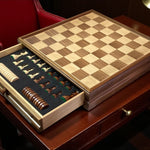
Inlaid boards deserve particular attention. Well-made inlay should sit level, with crisp lines between squares and no roughness at the joints. Veneered boards should be properly sealed and supported by a stable base, helping them resist seasonal movement. Solid timber can be exceptionally beautiful, but like all wood it responds to humidity and temperature. Fine craftsmanship manages these natural qualities; it does not pretend they do not exist.
Borders, notation and traditional design
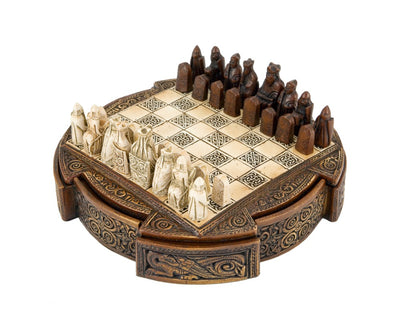
The border is often treated as a decorative extra, but it changes the character of a board considerably. A narrow border gives a clean, contemporary look and keeps the playing area visually prominent. A wider frame lends weight and formality, especially with tall Staunton pieces or ornate historic designs.
Algebraic notation around the edge is useful for learners, coaches and players studying games from books or scoresheets. It can make calling out squares and recording moves more intuitive. Experienced players may prefer an unmarked board for its uncluttered appearance, particularly in a formal playing room. Neither option is more correct; it depends on whether practical reference or visual simplicity is more valuable to you.
A traditional board does not need to be ornate to look distinguished. The enduring appeal of the classic chequered design lies in proportion, contrast and honest materials. A well-chosen walnut and maple board can remain appropriate through changing interiors, changing skill levels and decades of use.
Looking after a wooden board
A wooden chessboard benefits from straightforward care. Keep it on a level surface, away from radiators, fireplaces and strong sunlight. Sudden changes in heat or moisture can affect timber, particularly in centrally heated homes during winter. Avoid placing hot drinks directly on the frame, however tempting it may be during a long evening game.
For routine cleaning, use a soft dry cloth. If a mark needs more attention, use only a lightly dampened cloth and dry the surface immediately. Household sprays, silicone polishes and abrasive cleaners can dull or damage the finish. The board should not be soaked, and it should never be stored in a damp garage, loft or garden room.
When not in use, place a soft cloth over the board before storing pieces on top, or keep the chessmen in a lined box or case. This protects both the polished board surface and the felt bases of the pieces. With sensible handling, a quality wooden board develops familiarity rather than weariness - a record of games played, not a disposable accessory.
Buying for the game and the years ahead
The finest choice is usually the one that suits the owner’s real habits. A beginner may gain more from a well-proportioned, approachable board than an elaborate collector piece. A serious player may value tournament dimensions and a low-reflection finish above exotic timber. For a significant gift, the balance may lean towards presentation, heritage and a set that can become part of the home.
At Official Staunton, the aim is to make that choice clearer: matching traditional craftsmanship with practical guidance on size, materials and intended use. Take time to consider the pieces, the room and the games you hope the board will host. The right board will not merely display chessmen beautifully; it will invite you to set them out again.
Leave a comment